Categories
Greyhounds

Got ‘yah plus six months

It’s hard to believe Missy has been with us for 6 months, but she has. She is developing into a confident companion with a definitely playful and goofy personality.

Six months on, Missy is becoming comfortable in the neighborhood and is often out front on walks, is learning to visit with neighbors, and to be more comfortable around novel sights and sounds. She’s eager to go for walks and on rides to do errands. She still has mixed feelings about strangers. She’ll visit with some but is shy with others.

Missy has become quite the terrorist at the fence. She’s taken to chasing joggers but not walkers, and kids with wheels: bikes, skate boards, scooters, if they’re not walking, she’ll chase them. The kids have figured out that the fence is good so they largely ignore her. We are working on “calm dog”. I teach that at the door so they’ll stop bouncing and squirming to have leads hooked up to walk. They’re pretty motivated to go out so it is easy to teach. To my surprise, if I tell her “calm dog” as a neighbor walking a dog approaches, she’ll stay calm for much of the approach but she’s still getting excited once they reach the corner and are along side the fence. I think it will come with time.

Missy has become a frenzied digger. The photo above is of the hole she dug where there was once an aucuba. The landscapers moved it for me as part of a general back garden make over. They filled the hole with nice soft top soil which is now scattered. The plan is to make a boarder of paving tiles, put a layer of rock in the bottom, and add some sand on top so that they have a nice clean, dry nest for sunbathing.

Missy is determined that that is her hole. She’s taken to doing some frenzied digging, giving it a heavy marking, and back filling it a bit. Stinking Nick better not dare trespass on her hole.

Missy is playing less fetch but there are clearly times when she needs a ball thrown for her either in the back garden or in the house. The red ball in the photo is a favorite. It has a soft ribbed design that makes it fun to carry, toss, and snatch on the fly. This got quite animated one evening at sunset and included running yard-spanning figure eights. Missy always sat in the back racing, but probably because it was boring. She’s sure acting like she would have been a super coursing dog. She really loves chasing her ball and playing at it.

Categories
Photography

Introducing Speedy

Not another greyhound! No. That’s him on the masthead image. Speedy is part of the Chrysler Museum’s (http://chrysler.org) permanent collection. Speedy is proudly on display in the center of one of the sculpture galleries so you can walk around him to admire his physique. Speedy is cast in aluminum and handsomely anodized to a nice blue color from the palate of the real thing.

This photo is one I took on a visit to the museum using an iPhone 6+. The 6+ camera is nothing short of amazing in its freedom from noise, color fidelity, sharpness, and ease of use. You can’t do bokey (depth of field tricks) but you can take a damned good photograph with proper attention to composition, a proper grip, and use of the volume buttons as shutter release. Grip the camera with a finger on either button but not the standby button. Squeeze gently to trip the exposure and this camera will reward you with a sharp photo.

I used the on-board Photo application to realize this image. Just basic adjustments to darken the image and crop it some for the masthead. I did the crop here on WordPress.com. The exposure correction in camera post processing.

Speedy has a story that you can look up. It turns out that his sculptor is well regarded and that Speedy is a primary example of the use of anodized aluminum as a statue medium. And I just thought he was a stout hound!

Categories
Car talk

Save the Manuals?

I found myself thrown into the new car market a couple of weeks ago. A case of unintended acceleration resulted in the rear ending of my beloved 2001 Audi A4 Avant at a light in Virginia Beach. I was the rear-ended. The rear ender had pulled up to let a vehicle slip in behind while we were waiting for the light. To stop, instead of the brake, the driver stepped on the the throttle. When the car didn’t slow, push harder. Bang. The sad bit was that I was going to a club meeting that didn’t exist.

State Farm took one look at the car and called it a total loss. The hatch frame was badly warped and the way back floor was badly buckled. Beyond economic repair. Other than some brake light alarms, it drove home normally much to my amazement. At this point it was time to go car shopping, something I was hoping to put off while VW and Audi product plans had settled some more. Fortunately, they had settled enough that there were choices.

The Contenders

After several years of watching Top Gear, a year of the magazine, and regular reading of Automobile Magazine and Car and Driver, my short list of dog friendly cars was

  • Mini 4 door
  • Focus ST hatch back
  • Fiesta ST hatch back
  • Golf GTI

State Farm let me have a Fiesta SE as a temporary replacement vehicle. It took 10 minutes to figure out how to tune the radio. That pretty much took Fords off the list. Sync lived up to its reputation. I didn’t try to pair the phone or use the other features.

Meanwhile, the Golf is car of the year, the world over. All trim levels, all drive trains. Let’s start there. I ended there. My first choice was a white four door Golf GTI stick. There were none to be had but one of the first things I did was stick or auto. The stick was the nicest I’d driven with crisp gates, a robust feel, and nice clutch take up. I’d forgotten what a new clutch felt like! The automatic was inoffensive but I really had my heart on a stick. Save the Manuals and all that. I’d driven stick for 40 years and this may be their last hurrah.

Not your father’s slushbox

But there were none to be had unless I wanted the red two door on the lot. Red, done that. Two doors, done that. Time for change. I’d picked white and 4 doors (done 4). But in my old age, I need to open the door wide to get in and out. The shorter doors of the 4 door make that easier in a narrow carport (got one) or parking spot. So if I wanted white with 4 doors and a stick, it had to come from out of area. Well, who would have thunk white 4 door sticks were in demand. They were. The dealer would find one and the dealer holding it would have a local offer the next day. Two found, two sold at home.

What’s a slush box?

So I bought the DSG automatic from stock. This transmission is not your father’s slush box. That’s ’60’s slang for an automatic of the day. These beasts were 2 or 3 speeds, crude, and coupled to the engine by a torque converter. This is a fluid coupling that allows the engine to turn while the car is stopped with a gear engaged. It also allows the gears to switch by letting the transmission’s input shaft change speed relative to the engine speed when the switch occurs.

The torque converter works by requiring the engine to turn faster than the transmission input shaft to transfer torque from the engine shaft to the transmission shaft. This is called slip. It also makes the car hard to drive by sound and for the car’s motion to be somewhat sluggish relative to the direct connection of engine and transmission by a clutch. I never really liked driving an automatic. A ’56 Pontiac Turbo Hydromatic (3 speeds) may have had something to do with that.

What’s this dual clutch thing?

The VW GTI automatic transmission is a dual clutch sequential gearbox (DSG). This design is an evolution of Formula 1 and Rally technology tamed for city driving. The transmission input shaft drives two gear trains directly connected to the output shaft. The input shaft splits to drive two wet plate clutches, one for each path through the transmission. At any point in time, both clutches are disengaged when the vehicle is at rest, or one of the two is engaged to drive the vehicle.

The sequential bit comes in because the gears are engaged in order. The transmission can switch up or down by exactly 1 cog. It does this in a clever way. The idle shaft is preselected to the next gear to be used, one gear up or down from the current gear. Come time to switch, a little robot simultaneously disengages the driven clutch and engages the idle clutch. This process takes 10 milliseconds! And it is seamless. No slip. The engine note changes down and deepens, and the car pulls smoothly.

With the normal maps selected in the GTI (engine throttle map and transmission shift map), shifts are smooth and free of jerks. I knew it was smooth but didn’t realize just how smooth until I put the dogs in the way back to do an errand. I’m not the Stig so my shifting is 500 milliseconds or so and would rock the dogs around pretty good. I could occasionally put one on his or her rump with my heavy footed technique. They stand through DSG switches without noticing them!

The everyday maps are smooth. They get around town right. They get highway entrance right. The car just pulls smoothly switch, switch, switch. The engine torque curve is manage and flat over the power band. Cars with peaky torque curves feel fast. Cars with smooth broad torque curves are fast but don’t feel it. Driving to church, the car pulled up to highway speed without fuss and much quicker than I thought it had.

With a DSG gear box, the car is faster than with a manual box, even with the Stig stirring the manual. He just can’t beat that simple minded robot (or its adaptive control algorithms). And without torque converter slip, it is as efficient as a manual. With the every day shift maps in use, it delivers 28.5 mpg doing the errands across Norfolk and the Beach. The Audi (admittedly heavier) was good for 23.5 over the same weekly orbit.

That’s neat, but can it do the hard stuff?

Early DSG boxes were harsh around town. They were notorious for chatter. They didn’t like parking, neither head in nor parallel parking. VW has tamed the low speed chatter. The little robot running the engine and transmission will disengage and re-engage as needed for smooth motion in slow traffic. As you slow for a light, you hear the transmission shift down as the car slows.

Backing out of the carport, the roll off is a bit eager but easily managed with the brake. Once the car has figured out that you intend to creap, it does that well with a light foot on the brake. If it hangs up on the misaligned bit of drive, light pressure on the throttle takes it up onto the higher slab.

I can’t comment on parallel parking but the car is easily managed entering and leaving head in places. This is no harder than with a torque converter automatic. If fact it seems easier. With a manual, you normally touch the clutch to get rolling, disengage, and manage speed with the brake. The DSG feels like it is doing much the same behind the scene. Engaging to roll off but using the car momentum to complete the low speed move.

Categories
Home Remodeling

Appliance Shopping

When I bought 3444 Fletcher 10 years ago, I did so with the intent of remodeling the bathrooms and kitchen. In 2013, I remodeled the baths. In 2015 I join the ranks of the homeless while the kitchen is remodeled. This is a big project that sacrifices 5 feet or so of the car port to make a family entry, laundry, and pantry space adjacent to a remodeled open plan galley kitchen. This project will have the building apart for six weeks or so for demolition, construction of the addition, structural changes to open the kitchen to the lounge area, etc. During that period, I’ll be without hot water, the laundry, and refrigerated food storage. Once the structural bits are done, there is probably a month of interior finish to paint, install flooring, and install cabinets and appliances.

All of my appliances except the water heater are old and living on borrowed time. It is time to replace oven, cook top, washer, dryer, etc. The state of the appliance market in the United States is weird. Americans seem to want everything bigger rather than better so we have huge refrigerators and laundry machines. With time it becomes harder and harder to find equipment appropriate for older or smaller homes because fashion has moved on. This has caught several of us.

Design-Build

Cousin Bill Watson serves 1 percent clients in the Beach Mountain, NC area. Bill’s clients usually begin a project by hiring an architect and developing plans and specifications for the multi-million dollar projects that his company executes. Now you know why Bill has gray hair! The other 99 percent of us are usually working in a design-build project environment. These projects begin with a conceptual design that is sufficiently detailed to serve as input to the estimating and design processes. The builder engages a designer or architect and structural engineer as needed to develop construction plans in the opening phase of project execution. Most of the detailed design occurs between project award and permit application as foundation and structural drawings are required by the permitting process.

Why Pick Appliances before Award?

Aunt Betty, proud member of the 1 percent, just replaced her built-in refrigerator. The machine had become ill and, apparently, was uneconomical to repair. This turned into a $20,000 project. Built-ins are often 84 inches tall. How do you get it into the house? Will it fit where the old one was? What has to change? Is the condenser built-in or external? Even if you’re not so well off, you face similar issues. Can you get a 36x36x72 inch 400 pound blob through the house and into cabinetry? How does the machine size affect the cabinetry design? How much space is required left, right, behind, and above to actually get the machine in its pooka?

If you have bounding box sizes for each appliance, it becomes a simple matter for the designer, using his 3-D CAD software to verify that each object can be brought in, maneuvered to its proper location, and has service access. With the machine moved out of its pooka, is there sufficient room to replace the various field-replaced subassemblies? Checking now saves grief during interior finish. The washer-dryer was of special concern because it shares a closet with a tankless water heater. If I stack the appliances, can I get the stack in? Can I service it. How does the pooka change for side by side mounting?

Enter Energy Usage Standards

Energy conservation standards began during the first Oil Shock back in 1973-74. The southwest Asia oil producers, miffed by US support of Israel during the Yom Kippur War, cut off oil exports to those who helped Israel. Oil prices soared and some limited rationing began. The formation of the Department of Energy and the beginnings of the Energy Star voluntary efficiency standards and corporate average fuel efficiency (CAFE) standards trace their origins to this period.

In Europe, not having robust fuel sources, energy has always been expensive and European white goods manufacturers have always been at the forefront of innovative appliance design. European manufacturers perfected the front loaded laundry machine. Only one US manufacturer, Westinghouse, attempted to make a home front loader. Being more expensive than top loaders and having door skirt materials problems, Westinghouse abandoned this design in the ’70s. Front loaders were more energy efficient (used less water) and washed better but cheaper won over better in the US.

European homes are also smaller, so European and Asian appliance manufacturers have designed efficient yet compact appliances for their home markets. With the changing regulatory climate in the US and changing customer preferences, they have begun to offer these advanced machines in the US market.

Condensing Dryers

I’ve had a condensing furnace for nine years. Does anybody make condensing dryers? Yes, Whirlpool, Bosch, LG, and Samsung do. How does a condensing dryer work? Regular dryers use an open cycle. They draw in room air, heat it and move it though the drying drum and discharge it to a vent to be released outside the structure. During dryer operation, outside air is drawn into the building and must be heated or cooled.

A condensing dryer uses a closed loop drying cycle. The air handling draws air from the drum, passing it trough an air to air heat exchanger and heater on its return to the drum. A smaller heat source starts the drying process. As the warm air begins to evaporate water from the clothing, the air to air heat exchanger cools the drum exhaust air recapturing the heat that evaporated the water to be used again. The condensed moisture drains to a tank and is pumped to the building drain system.

The most advanced machines of this type use a heat pump to supply the heat input to the drying process. The heat pump extracts heat from the room air and transfers it to the drying air between the condensing heat exchanger and drum. In essence, the heat pump is a small refrigeration machine that heats the dryer air by cooling the room air. The heat transferred to the drying process is greater than the electrical input. There is no free lunch. Building heat gains or the building’s heating plant supplies the heat that is transferred from the room air to the dryer air.

A condensing dryer has the advantage of using only 115 volt power in the US and does not require a vent, just an second drain connection like that used by the washer.

Combo Washer-Dryers

In Europe and Asia, it is popular to install the washer-dryer in the kitchen. By using a front loading design, the same drum and motor can serve both the drying process and the washing process. In both machines, an outer drum surrounds the clothes drum and contains the water or drying air. The washer is the more demanding of the two because the drum must be water tight. Water tight is also air tight. It is a simple matter to package the dryer heater, blower, and condensing heat exchanger in the same cabinet as the washer components.

There is a catch. Combo machines can wash more than they can dry. The machine must be loaded based on its drying wight rather than its washing weight if you intend to wash and dry in a continuous run. If you load the washer to its full rated wash weight, the wet clothes must be split into two drying runs. Being single, it becomes pretty easy to manage my washing to allow the continuous wash dry process. Gone are the days of stuffing the drum full from a heaping laundry basket. This means an additional load each week but washing whites and coloreds separately (sounds a bit Jim Crow) naturally leads in that direction. For those with kids, the battle rhythm is to do a load each day rotating around the household members.

The advantage of a combo washer dryer is that no stacking is needed. This solves the problem of sneaking a tall washer dryer stack past the tankless water heater. Those with large families often buy a matching condensing dryer, load the washer full, and split the drying between the two machines.

Refrigerators

Somehow, the appliance industry has convinced us that we need ever larger refrigerators. When I first moved out on my own, 15-16 cubic foot units were the norm. Today, you are hard pressed to find machines smaller than 21 cubic feet. TARDIS technology not being available, to be larger on the inside, they must be larger on the outside. This results in height, width, and depth growth of machines over time. Mandatory environmental and energy efficiency standards require better and thicker insulation, larger heat exchangers, different refrigerants that don’t burn holes in the ozone layer, etc. All of these technical forces tend to make for a bigger box. In anticipation of this trend, I had a local handyman shorten the cabinet mounted above the refrigerator to accommodate a taller machine should I have to replace mine before I was ready to remodel the kitchen. The new kitchen will be designed with a bit of margin.

Selection Considerations

My space and door constraints require a shallow refrigerator that will fit through the exterior doors. This pushes me to a “cabinet depth” machine. In reality these are 29 to 30 inches deep, 36 inches wide, and 76 inches tall. This is about the largest unit that will come into the building through a 32 inch door, my bounding constraint. When thinking about this stuff, remember the doors and handles. Most “cabinet depth” machines stand proud of the cabinet by the door and handle distance. This is needed to allow opening the doors without requiring additional width to accommodate the open doors. LG is one of the better manufacturers when it comes to giving measuring guides.

US refrigerators are generally Energy Star rated. Energy Star now has tiers. The best machines are tier certified. The European standards and standards process are different and Europe uses 220 volt 50 Hz power. Machines tend to be made for one market or the other. Europe does make smaller cabinet depth, 24 inch machines but these are deemed too small for the bigger is better US market.

Current Fads

The current market taste in refrigerators is for a bottom drawer freezer and top refrigerator with multiple condensers, one for the freezer and a second for the refrigerator. These are a bit more expensive and a bit less efficient than the older top mount design. The advantage is that they offer better access to refrigerated foods. The following factors influence price.

  • Exterior material. Stainless steel is extra
  • Interior bins and shelving.
  • Door bins. More expensive machines have more flexible door bins
  • Freezer drawer bins. More expensive machines provide removable baskets making storage more flexible.
  • In door water and ice dispensers
  • Internal ice maker and water dispensers
  • No ice and water dispensers

Through door ice dispensing failures is the largest cause of machine trouble. An inside bin is fine!

Through door water dispensing is a cleaning problem. The little drop tray loves to grow mold and is the devil to clean. These are two dumb features that I’ll forego.

Cooking

My cooking preferences are for a separate cook top and oven. I like the option of storing the pots and pans beneath the cook top and having the oven at a height that is easy to load and check. I bake bread for myself so having a good oven in a usable location is important. It needn’t be fancy, just predictable in its behavior. Bells and whistles aren’t needed but self-cleaning is nice. In my vegetarian phase, I make the occasional pound cake to celebrate birthdays, roast vegetables, etc. but rarely cook meat or bake cookies (requires too much attention).

I often make beans and rice concoctions with a taste for middle eastern, Caribbean, and African fare that is naturally vegetarian and makes rich use of spices. Every now and again, I’ll make a batch of all meat chilli for the freezer and space out its consumption to keep the gut beasties mostly vegetarian.

Cook Tops

This is my one splurge in a more moderately priced kitchen. I’ve been living with a radiant cook top and like it but it stays hot making it a bit of a safety hazard if a curious dog puts paws up on a hot element. That led me to consider an induction cook top. Talking with friend Pat Ives, she has a new one and likes it after making the move from radiant.

Radiant or Induction

One of the great things about both radiant and induction is that pan temperature responds pretty quickly to controls. It is as convenient as gas in this regard, just not as hot as a restaurant gas burner. Stuff has to be cooked in smaller batches.

Interestingly, induction is beginning to rule for sauce and desert-making tasks in restaurant cooking. Induction is becoming preferred for soups and sauces because of its feedback control of pan temperature and uniform heating of the pan bottom for temperature sensitive processes. Controlled even heat is an advantage for frying bacon, scrambling eggs, cooking steaks and burgers, etc. On the rare occasions that I cook meat, I’d just as soon not have an operational test of the smoke alarms. With radiant, I’ve let the pan temperature get away and listen to the alarms for an hour!

An advantage of both induction and radiant over gas is that they provide smooth counter space when not actually in use for cooking. Skoshi counter top, I knead bread and do other non-violent tasks on the smooth surface of the radiant cook top.

Being leery of  electronic controls, I opted for knobs when I purchased the radiant top. This time I’ll go with touch controls. Touch is the only way to get the magical features.

How Induction Works

Induction cook tops use electromagnetic skin effect to induce circulating currents directly in the cookware. For this to work, the cookware must have magnetic material, usually cast iron, carbon steel, or magnetic stainless steel (18-8) in the cookware shell. The material may be cast, roll bonded, or bonded during the stamping process. All induction cook tops, portable and built in, have pot sensors and will trip when the pot is removed or will not start if the pot has too little magnetic material to work correctly. Magnetic disks are available to use with non-magnetic specialty pots. These work like the old solid disk cook tops of the 80’s.

Cooktop Size

Larger gets more elements and more flexibility of use but requires a 40 amp circuit. Most 30 inch cooktops require a 30 amp circuit. Something to keep in mind. If you are running new wire, run a 40 amp circuit even if you install a 30 inch cooktop. If you switch sizes down the road, you are good to go. I ran into this when replacing a 70’s cooktop with a modern cooktop. The newer product needed a 40 amp circuit even though the one it replaced was 36 inches. Once you have a cutout, you’re pretty much committed to that size for the life of the counter top which can be forever with granite. Unlike refrigerators, cooktop sizes have stayed in the 30 to 36 inch range. Fortunately, they’ve not grown to aircraft carrier size.

The 30 inch cooktops usually have 4 usable elements, and 11 inch element, a pair of 8 or 9 inch elements, and a six inch element. The 36 inch cooktops usually have an 11 inch element, a pair of 8 or 9 inch elements, and a pair of 6 inch elements. As mentioned above pot and element size must be matched fairly well. A large 11 inch element will not be happy with a couple of quart sauce pans sitting on it.

Pots and Pans:

Induction requires that pots and pans be magnetic. The magnetic tricker that makes induction cook tops work requires matching of pot to element. The two must be of similar size. Induction cook tops have sensors that stop the cooking process if a pan is not present or does not interact with the magnetic field correctly. The following types of cookware are known to work.

  • Magnetic stainless steel like those made by All-Clad
  • Other cookware with the induction symbol stamped on the bottom
  • Cast iron cookware like that made by Lodge
  • Carbon steel cookware like that made by Lodge

Today, a helical squiggle stamped on the pot base identifies induction capable pots. If this pot is not Lodge cast iron and does not have the squiggle, don’t buy it. Even if you have a radiant cooktop, new pan purchases should be induction capable pans.

Fussy Cooktops

Pots and element sizes must be matched. Putting a small pot on a large element will cause the element to ignore the pot. Pot and element must be close in size for the element to recognize the pot and heat it. This and the sensitivity to material caused some interesting behavior in older induction cooktops confronted with randomly chosen but induction ready pots.

YouTube has a number of videos of confused cooks trying to cook with “induction rated” cookware that their stove cannot sense. Sometimes the stove ignores the pot entirely. Other pots are sensed on some burners but not others or if they are moved onto the cooktop just so. This seems to be an issue with earlier cooktops and with Asian brands.

Bosch has a feature in its Benchmark cooktops called Flexinduction. What Bosch did was to make a rectangular cooking zone having four elliptical coils that can function independently with small pots, in pairs with larger pots, and together to heat a grill or griddle. These elements have been designed to be pot insensitive. Bosch has a video of a demo unit made with a white top and back lights showing the active element. They put a pot on, move it back and forth, and the light follows the pot, firing one or two elements as the pot moves off of one element to a second. This top was able to heat a small espresso maker, a 1 quart sauce pan, 2 quart sauce pan, etc. The elements may be used independently, in pairs, or in fours.

In its other lines, Bosch makes a point of mentioning that it has robust pot sensing logic. Apparently, they are well aware of this issue and have been careful to design the pot sensing to be robust and predictable.

Categories
Recipes

What the Hey Do You Do with Dried Beans?

Several weeks ago, Luke Murden, our 757 Whole Foods Cooking Coach, demoed preparation of Swedish brown beans. These medium sized beans have a mahogany color and make a delightful thick stock as they cook. I grabbed a copy of Luke’s recipe, stuffed it in a jacket pocket, and hid it. A couple of weeks later, I tried to make the beans by memory with guidance from Joy of Cooking and Fannie Farmer but failed miserably. Changing coats, I found Luke’s recipe. So here goes.

Cooking Time

This recipe requires about a day for overnight soaking of the beans and about 2 hours to cut up, assemble, and cook.

Tools

  • 3 quart or larger vessel in which to soak the beans
  • 5 quart Dutch oven
  • 2 quart prep bowl to hold diced stuff
  • monkey dish to hold measured spices and garlic
  • chefs knife
  • cutting board
  • 4 ounce serving spoon

Soaking the Beans

All beans contain long chain saccharides (sugars) that digest in the large intestine rather than being absorbed in the stomach. In the gut, bacteria digest these saccharides making copious quantities of carbon dioxide among other metabolic products. The end result is a flatulent diner.

Soaking the beans over night removes the saccharides. The beans will expand by a factor of 4 during soaking. Use 1 quart of pot volume per cup of dried beans. For most recipes, a 3 quart pot works. Add the beans and fill the pot to within an inch of the top and cover. Let sit undisturbed until morning. In the morning, change the water and continue soaking until ready to cook.

It is important that all the beans be covered. Add water as needed to maintain liquid over all the beans.

Carnivore Option

Buy a quarter pound or so of your favorite sausage (Italian, andouille, chorizo). Skin the sausage, mush it flat with a board knife, and scramble it while browning. Remove the sausage and reserve the oil to begin the vegetable sauté step. Once the vegetables are sautéed, add the browned sausage.

Vegetables

The vegetables listed are those required to make Luke’s learning recipe. You can go big on all of these to produce a chunky result or to make bean soup.

  • 2 carrots diced
  • 1 large stalk of celery diced
  • 1 medium onion diced
  • 3 cloves of garlic minced
  • 1/4 teaspoon of red pepper flakes
  •  1/2 teaspoon dried thyme
  • 1/2 teaspoon dried basil
  • 1-2 bay leaves
  • optional 1 or 2 cans of fire roasted diced tomatoes

Dice all of the vegetables, probably 1/2 cm dice. Mince the garlic. Sauté these as follows.

  1. Add olive oil to cover the bottom of the pot and begin heating, 2.5 to 3 on electric.
  2. Add the spices to the cold oil and warm until some bubbling is observed. The garlic may go in at this point.
  3. When the garlic begins emitting steam, add the onions, celery, and carrots and stir to coat with oil
  4. Cover and roast for 20 minutes at low heat.

During the roasting process, the vegetables will reduce in volume and begin to caramelize. If you prefer, you can continue until some color is developed but take care to reduce the heat. By the 20 minute mark, most of the liquid will have been liberated and the temperature of the brew will begin to rise. Keep a close watch reducing heat as needed to prevent burning.

Cooking the Beans

This is where I went wrong in my first go. Back in the day, Fannie Farmer, Myrtle Hamby, and Ethel Watson cooked their beans in an excess of water, typically 4 to 5 cups of liquid per cup of soaked beans. At the end of cooking, they drained the beans and discarded that great stock they had just made.

Luke Murden’s method uses 2 cups of water per cup of dried beans. When I made my beans, I used 2 cups of dried beans and 2 liters of water (1 to 4 ratio). As a result, that delightful thickening that occurred during Luke’s demo went missing in my go. So don’t do as I did, do it this way.

  1. Drain the beans
  2. Add to the vegetables and stir up well
  3. Add the 2 cups of liquid per cup of dried beans
  4. Add 1 teaspoon of low sodium Better Than Bouillon per cup of dried beans
  5. Let this simmer until everything is well mixed
  6. Cook about 1 hour until beans are soft and some gravy begins to form
  7. Taste the broth at this point and adjust salt and pepper
Categories
Web hacking

oduilr.org goes live

This has been a busy week bringing http://www.oduilr.org live. Earlier, I wrote an article about developing an Open Outreach Drupal 7 based site for my church. This summer, I joined ODU Institute for Learning in Retirement and joined the communications and technology committee. At the first meeting I found myself volunteered to become webmaster and committee chairman as both incumbents were eager to move on to other roles.

The old site at http://legacy.oduilr.com was originally developed in the early days of ODUILR using Microsoft Front Page. The site had a dated look and was difficult to update. It was appropriate in the club’s early days but now that we are 700 members and 100 or so programs, social events, and trips per year, the organization has outgrown the old site.

Categories
Greyhounds

Got Ya plus 2 months

Wild Child Full of Chase

Missy is now my wild child full of chase. She is a living fireball full of adolescent dog energy. Generally, she’s quiet about the house but let her out in the dog paddock and she’s a wild woman. She loves to play with her stuffies, mostly hunting play. She’ll charge them, snatch them from the ground, and go ripping about with them, often throwing them into the air. Thankfully, she’s more restrained in the house but she can get pretty bouncy when cabin fever sets in.

Missy’s house manners have been impeccable. She’s a bright girl and assertive. When she needs attention, she comes and asks and has paired words to activities. So 20 questions is beginning to work with her. This skill is always a big help to identify what a needy dog act is about.

Nick and Missy Get On

Nick and Missy Together

Missy and Nick are comfortable in close quarters and get on well. I’ve not seen any possessiveness or indications that one feels that the other is a favored child.

Missy knows how Nick asks for food and comes running to clean up anything he doesn’t eat. Missy’s Delta Tau Chi name is Hoover! She eats everything in sight. That’s why they are “sight hounds.” Unattended food is hers except when Nick gets there first.

That said, Missy has impeccable table manners. I feed her first while preparing my dinner and Nick and I eat together. Missy lies quietly while Nick eats but is right there for leftovers. I’ve been picking Nick’s dish up so he can have his leftovers later. Nick is a picky eater on his current food so I’m going to look about to see if I can find something he likes better.

But he and Rhea always grazed and I could free feed them by measuring out two rations twice a day and letting them nibble as they would. Not with Missy Hoover in the house!

Play

Missy and Nick play a bit in the yard but Missy is a bit fast and rough for old man Nick. He often ducks and covers in the car port when he’s had enough play. She’s full of adolescent energy and will lead Nick about the back garden and then double back on him. All in good fun but greyhound fast and rough.

Sleeping Arrangements

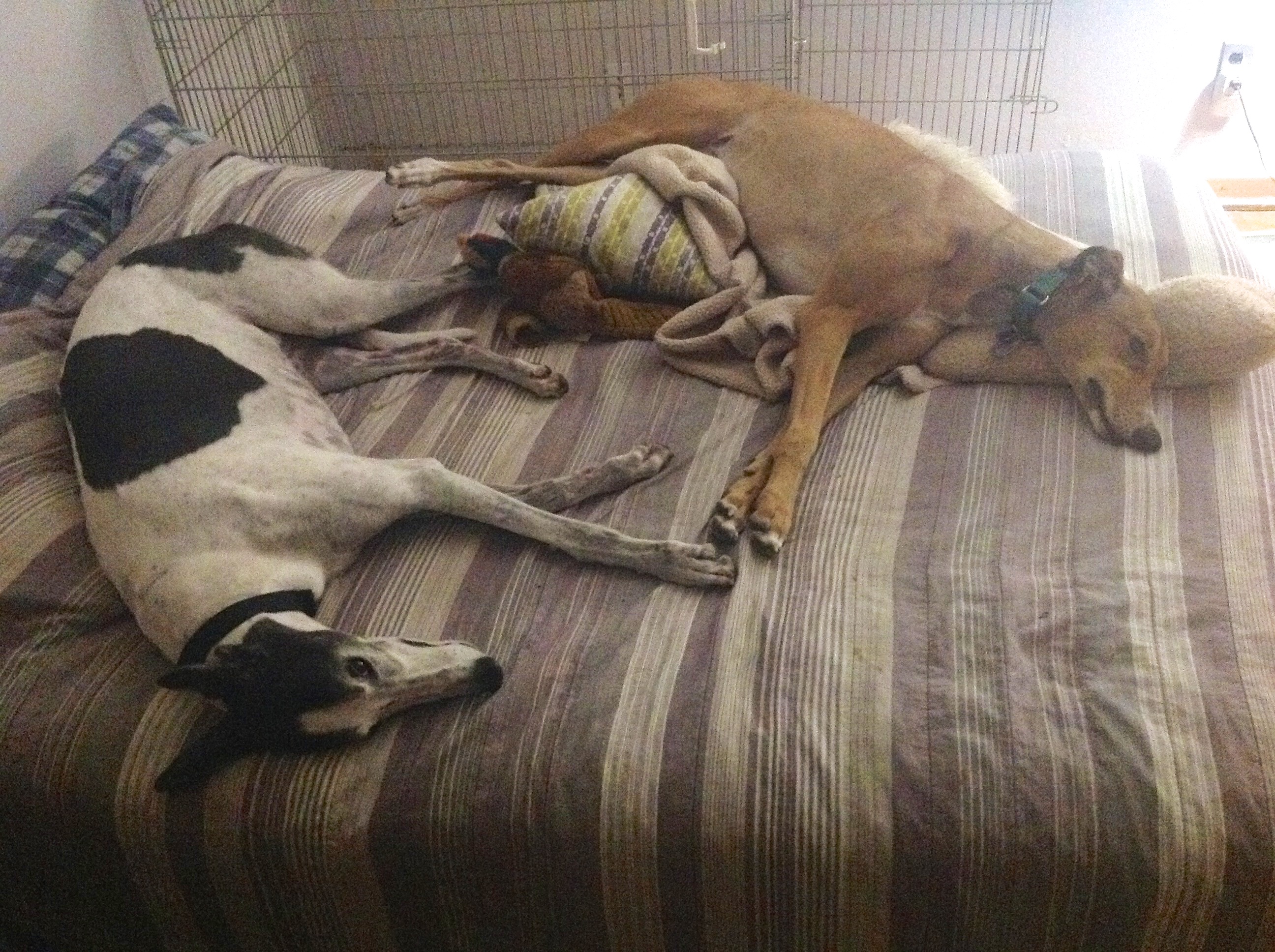
My bed hogs left me the crate

Now that it is cool in the evening, Missy or Nick or Missy and Nick will hop in bed with me. Missy is clever and settles by the feet where there is room. I suspect she learned this skill from Jennifer in a single bed while at Second Chance. Nick has been working on it for 5 years but I suspect there is method to his selective amnesia. He plops down across the pillows and won’t budge until bribed to move. He’s definitely trained me to produce a cookie at bed time!

Missy’s Film Career

I’ve been accumulating a good bit of dog play video. It’s a good way to document their development and to keep entertained when bored. I started filming Lance and Rhea while in Rhode Island. Greyhounds always get frisky in the light snow at the start of a storm so I began by taking snow storm video and just sort of kept on. I’ve been editing the clips in iMovie and posting them to my You Tube account which you can find from my Google+ profile.

This clip is of Missy and Teddy in the back garden. Victor Wooten’s The Hawk from his Music Lesson record provides a groove. The Music Lesson has an accompanying text designed for guided self-study in jazz improvisation. Victor’s text is groove player oriented but these short pieces seem designed for a student to play along either as a grove player or to build improvisation skills.

Categories
Holiday Letter

2014, That was the year that was

I’m doing something novel this year. I’m actually writing my holiday post in the year it is about. Usually, I keep putting off holiday cards and the the holiday post. This whole business got started in 2006 when I moved up north to Rhode Island and it became difficult to make the Thanksgiving and Christmas pilgrimages to visit the relatives. The 2 day drive from Newport was too long, especially with dog lodging and wee breaks. So I started a Facebook page and began writing the yearly letter to send out with Holiday cards. Over the years, the on-line community got larger and a good bit of it (second cousins) were mobile making it hard to send cards. The card list is down to 10 or so retired moochers.

I Joined the Retired Moochers

Medicare sets you free! In January, I joined the retired moochers. Several cousins had preceded me by retiring early. With the health insurance situation in the US, I felt compelled to work until 65 when I became eligible for Medicare. So I retired at the end of 2013 having given my employer a year’s warning that i was going to bail. I don’t miss work one bit. Since moving from Newport to Norfolk, my command had become increasingly dysfunctional, largely as a result of the location down the street from the real Navy but also as a result of some unfortunate choices of support staff. IT was trying to wag the dog in modeling and simulation and the security pukes were getting increasingly obnoxious, and I was becoming less connected to the product over the last couple of years.

Categories
Greyhounds

Got-ya + 2 weeks

Petting Out

I can’t brag on Missy enough. She’s been so easy after a couple of tense days while she was deciding we were keepers. Just 3 months ago, she was in a racing kennel at the Mobile Greyhound Park, a dim spot in the industry. After 40 starts, she was retired because she ran in mid-pack with no prospects for improvement. She received her pre-adoption health care in Mobile. From there she went to a Florida minimum-security prison to go through the Second Chance at Life foster care training program. After 2 months with her trainer in a dormitory environment, it was into a dog hauler for the trip to South Hill and by car from South Hill to Norfolk. Missy spent several hours with Old Dominion Greyhound Adoption. Sam and Gay Latimer looked after her for until I could hook up with them for delivery in mid-afternoon. She was pretty wary but eventually she was willing to load up for the ride home. We delayed delivery until after I had finished a morning engagement so I could stay with her to begin the bonding process.

First Days Home

Greyhounds bond with their new pack mates during the first two or three days at home. Until bonding is well underway, risk of a loose dog running off is pretty great so you can’t be too careful with doors, gates, and comings and goings during the bonding period. Missy pretty quickly decided she had it good and should keep Nick and I. The changes during the first 3 days were pretty dramatic as she dropped the shyness and learned the household routine.

Around home, she was uncertain of me and some spaces at home, especially the sally port into the back garden. This is a narrow area between the car port shed wall and the side yard fence that is about 3 feet wide and 5 feet long. She really didn’t want to go in there, probably a reaction to rough handling being loaded into the starting boxes at Mobile. Over the first week, this behavior gradually resolved itself with patience and gentle leadership on my part and lots of treats.

Missy and Nick

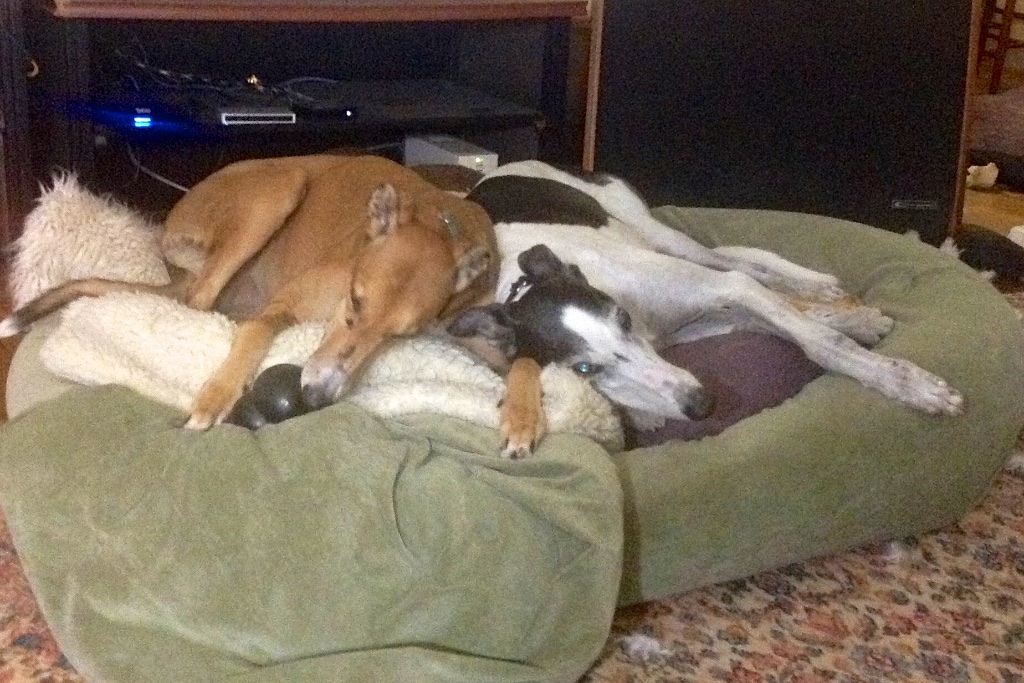
Missy and Nick hit it off pretty well. There’s been amazingly little indoor posturing on Nick’s part. For the most part he has been gentle with Missy and Missy has been comfortable with normal encounters in the confined spaces of a small mid-fifties modern hip roofed ranch. It is not unusual for there to be some telling off when a hound approaches a lying hound but she’s told Nick off only twice that I’ve seen and he’s not told her off. As you can see, they are both comfortable piling on the big Bowser life raft bed and will share my bed.

While I’m Out

I’ve let them have the run of the house unmuzzled while I’m out. I’ve tried to limit trips to 4 hours or less so we’re not testing Missy’s endurance limits. So far no signs of separation anxiety or unpleasantness during my absence. I expect this will continue as both are generally well behaved while I’m in.

The Back Garden

Missy likes to rip about with a ball or stuffy and actually plays fetch. Nick may be angling for a more dominant position while they are out in the garden. I’m seeing some posturing during chase play. If there is some tension, the dog in back will do some vocalizing and possibly some air snapping.

Missy will start play with a stuffy, Nick will get in trail and hang in for a few laps with some vocalization. Missy will entertain him for a few laps of the garden then turn out and tell him off. You can see this in this video. I pieced this together from short clips taken over the past two weeks. So far, no bickering matches and no evidence of teeth.

The catch is that most outings are calm and orderly. It is only when I get Missy spun up with a toy that this happens. Nick ducks out into the carport for a bit, screws up his courage, and emerges for this bit of chase. Nick is starting to feel his 8 years and Missy is still less than 3 and track fit. Fortunately we have 40 by 90 fenced so they can’t get going fast and are always in sight. I’m working on teaching them to come to me when things appear to be escalating. So far, so good.

Walks

During this period, I gently introduced her to walks in the neighborhood. You have to let them take things at their own pace. It can take a while to undo the harm of a scary encounter with common neighborhood hazards like children, other pets — especially those with rough coats who appear aroused to a smooth coated greyhound, charge the fence dogs (greyhounds are particularly sensitive to fence posturing), cats, the hoody shuffle teen, etc. So far, this process is going well but we are careful of when we are out and that we’re away from the bus stops when school buses are releasing packs of rowdy children. I’m also careful to alert folks at a distance that Missy is newly retired and may react to them. If I see ears go up, I get the dogs onto a yard and we watch whatever prompted the reaction pass. So far, so good.

After 2 weeks, Missy likes walking with Nick and Nick seems more confident with another hound at his side. This summer he was becoming shy about walks after being charged by a couple of loose dogs and an encounter with a nest of tracker-jackers (red wasps). Yes, one trial learning is possible. He avoided that street for a month. Missy was a bit uncertain out in the hood the first week but she’s getting pretty confident and will walk our two favored blocks (less dog posturing at the fence) relaxed and in a decent heel. When she’s concerned, she’ll constantly change sides and generally be obnoxious so I am glad to see this development.

Supper

Jennifer taught Missy table manners so we were off to a good start for my meal. Missy’s Delta Tau Chi nick name is Hoover. She puts her food down pretty quickly then shifts suction to Nick’s dish. Not a dog to free feed. Her idea of free feeding is “food is free so I should eat it all.” So Nick and I are working out how to feed Nick. What works best is to feed Missy first, then feed Nick while I eat. Missy is good about taking a place in the corner and staying to be fed treats once her supper has kicked in and she is feeling satiated. The hard bit is to get Nick eating again on a schedule. I’ve cut his ration a bit so he’ll eat it all and we all eat together (approximately) as described above. Fortunately, Nick is not shy about asking for seconds and only as needed. He maintains weight well.

Categories
Greyhounds

Missy’s Foster Mom

I thought I’d take a few minutes to introduce Jennifer, Missy’s trainer in 2nd Chance at Life’s inmate dog training program. Over the years I’ve heard stories about correctional institutes working with outside groups to introduce selected inmates to dogs and dog training. These stories have been favorable with good rehabilitation for both dogs and inmates. The rescue dogs get a chance to start a new life and the inmates experience the joy of life with dogs, learn compassion and responsibility, and dog training skills.

Missy came with the following wishes from Jennifer.

  • To never have to be scared again, to only be happy.
  • To have a big yard to run around and catch balls.
  • Lots of yummy treats and maybe even some peanut butter
  • A big, fluffy, comfy bed or to be able to sleep with you in yours.

Jennifer’s Letter

Jennifer wrote the following longer letter

Thank you so much for adopting this sweet, amazing girl. Im sure she will seem a bit scared at first but give it a little time and I know she will get used to you and trust you. You are going to be happy with her.

Her favorite thing to do is play catch. She has so much fun playing with toys and balls. That could be a great way to get her out of a fearful state.

When God chose me to train Missy, He is always right. God always knows exactly what’s good for everyone. He truly blessed me when He put the two of us together. She is a spectacular friend and her love is amazing. Get ready to laugh at her goofy personality. I am so grateful for the time we got to spend together.

I pray you are blessed even more than I was, and that was a lot. I pray you guys live a long, happy, and joyful life. A life filled with love and peace. For an abundance of blessings.

Thanks for being the greatest part of the Second Chance at Life Program. Without people to adopt the dogs we would be doing this for nothing. But you make it possible for these dogs to leave hear and go on with their lives the way they were meant to. To be the animals they were born to be. Also, you make the Second Chance available to us here in prison. 

Jennifer

PS: Please do not crate

Thank you, Jennifer

You did a great job with Missy’s transition from track life to home life. Adopting a greyhound is always an adventure and I’ve had some that were messy rooms when they came to me. But with patience, consistency, and creative use of peanut butter, most problems can be solved in time.

Lord Nick, Missy’s consort, is an outgoing adventurer originally lacking in emotional control. Easily frustrated, he spent his first year with me being a total delinquent. At the end of our first year together (his 4th birthday), the frustration behaviors came to a stop and he’s matured into a normal adult. Four years on, he’s as nice a male greyhound as you’ll ever meet.

Nick and Missy hit it off pretty quickly as Nick escorted Missy around the back garden and showed her the house routine. She amazed me by recalling at the end of day 2, sitting on cue at the end of day 2, and by actually playing fetch. I’ve only met two former racers that would play fetch and Missy is the second. You’ve done a great job at getting her started.

I know it is tough to give one up. Foster dogs have a way of coming to stay out in the world. She’s been a real joy. We both fell for each other pretty quickly. As you know, it takes about 3 days for them to decide to keep you and she’s done that. Your compassion and concern for Missy are touching and the notes that you sent along with her have proven invaluable to me in helping her bond and settle into the household.

It was invaluable to know that she liked to play ball. Saturday morning (day 2), Nick wanted out at 0600. Missy hopped up too so I took them both out to the back garden without putting Missy on lead. She played little miss spook for 2 hours while I went through every stupid human trick I could think of to get her to let me approach and put her on lead. Then I remembered the note about balls and ran in to retrieve this dodge ball sized red thing that is designed to squeak and to be carried. It had sat unused as Nick and Rhea totally ignored it for several years. A few squeaks and the game was on. I played fetch with her until she finally tired, flopped down into a submissive position, and let me hook her up. Since then, we make it a point to play fetch on each long outing.

That note and the caution not crate here were invaluable. When I have to leave them alone, I’ve been turn-out muzzling and baby gating them. They use the back bedrooms (mine and my study) when I’m out. They quickly settle and nap until I return. I don’t think I’ll need to muzzle them. I took the photo up top after day 4 morning turnout. They are already comfortable together in tight spaces!

I hope things continue to go well for you, that you have more pups to train, and that you have a successful return to the world when your term is up.

Dave