Categories
Personal Computing

Airmail?

For some years, Ive been looking for an alternative Email client for the Apple Universe. I’ve finally found one I like. Most alternative clients worked only with Gmail. This one works with iCloud, Yahoo, Microsoft, and other popular mail services that support POP, IMAP, or ActiveSync.

Unboxing

I bought the program for the princely sum of $10 on the App Store. It launched and configured without issue.

I have 2 step authentication enabled on most accounts so I had to do the following extra stuff.

  • Create an iCloud App Password
  • Do Apple 2 step authentication
  • Do Google 2 step authentication
  • Add the first account at startup
  • Add the additional accounts from Preferences (like Apple Mail)

This took a little fumbling around but Google found the appropriate instructions at Apple Support quickly and all worked as advertised.

Reading Mail

Once my accounts were set up, I could read my mail in a unified inbox or check each account inbox. Articles can be archived, deleted, snoozed, starred, etc. I never really warmed to the Google Inbox idea of using an AI to sort Email into the those likely needing action, those that were informational, and those that were adverts, etc.

The reader interface is modern, easy to figure out after using the traditional Apple and Gmail interfaces, and it was easy to review and clear new mail.

The program silently imported my Apple Contacts, Apple Calendar, and Apple mail archive. Everything was there and indexed. Many products ignored the existing mail archive and started a new one. It is a pleasure to see that Airmail uses the existing MacOS mail archive.

Writing A Message

The Airmail composer is a joy to use compared to Apple Mail compose window. In Apple mail, I always disliked the start as plain, switch to html, and difficulty with bold, italic, and lists, particularly terminating a list. Airmail’s composer has solved all these issues.


Categories
Uncategorized Video

TabloTV Update

A couple of years ago, I wrote about Tablo TV, an off-air DVR product. Since then, TabloTV continues to improve with an Apple TV 4 App in the works (real soon now). TabloTV made firmware updates to support the app but the app is still awaiting release.

Plex

Plex is a OS independent media server that runs on Linux, MacOS, and Windows. The server component is free with the clients a la carte. There is also a subscription option that enables watching content away from home.

Plex has plugins that allow Plex to present foreign content such as Tablo TV recordings and live TV. I’ve started using Plex to watch the evening news and recorded content. The Plex Tablo plugin has a much nicer interface for viewing content than that in the iPad app. The plugin is unable to manage schedules or recordings but it allows AppleTV 4 to play content without AirPlay from an iPad. My iPad is free for ill-behaved apps like Facebook (network hog).

Recommendations

All of this stuff works well enough that I’ve been using Plex for most of my audio and video playback. The Plex Media Server is mature, the Plex ATV plugin is mature, and the iPad client is mature.

Once the TabloTV AppleTV client becomes available, it should be possible to manage recordings and schedules directly from AppleTV. Until then, the Plex TabloTV server plugin will fill the bill.

Categories
Eating Exercise

Makeover update

I’m about 16 weeks in on Strong lifts 5×5 so things are starting to get interesting. Being a retired moocher, I elected to lift after lunch and quickly found that appointments and other activities claimed one workout day a week. So I’ve been lifting 2 times a week rather than 3. For an older person (over 60), this may be good because recovery ability slows significantly after 40.

Progress

Sixteen weeks on, I’m through the easy stuff and the military press and deadlift are becoming challenging. I’m stalled on the military press and had my first lift failure on the deadlift at 225×5. Bench press and rows are still well away from stall point and squats still have a way to go.

I’ve learned to do each of the lifts without discomfort and with decent form but still feel a little goofy in the squat and a little uncertain of back posture in the deadlift. This is where a coach comes in handy. If you miss the technique by a bit, you sense it as you’re doing the movement. You feel off balance and have to muscle the weight back into balance. But if the back is not quite right, you can’t tell.

My weight has crept up the last couple of months. I’m attributing this to two things, trying to add protein by adding a fruit smoothie with whey power to the diet. This added a meal’s worth of calories. The second is that I’ve had Saturday bacon and eggs and weekend waffles for breakfast for a few weeks.This adds a good bit of sodium to the diet and causes a weight uptick until the excess sodium works out.

Last salty food for a while and I’ve dropped back to a chocolate whey milk shake with far less calories than a cup of yogurt with a couple of cups of fruit and whey. Surprisingly this was about 550 calories with unsweetened yogurt and mixed berries. A whey whole milk shake is about 1/2 the calories.

References

  1. David Laid Magic Leg Workout
  2. Qwin Vitale: Building big powerful legs
  3. Jon Candito How to Squat with Proper Form
  4. Jon Candito How to Deadlift with Proper Form
  5. Omar Isuf on Military Press
  6. Mehdi’s Stronglifts 5×5 site
  7. Ars Technica Biggest Loser Study Story
  8. Wikipedia on Body Mass Index

Things I’ve Learned

It has been an interesting journey over the past 4 months. Strong lifts 5×5 begins slowly, good for novice lifters. The slow start gives time to learn to perform the 5 movements correctly. The squat, deadlift, and military press were the harder lifts for me. But I also had to unlearn some 90’s bench press “knowledge” that didn’t stand the test of time. Mostly, the importance of maintaining the lumbar arch during this lift. I’m going to talk about some of these things in more detail.

Strong lifts 5×5 Audience

Strong lifts 5×5 is a beginners program designed for general strength building. The program starts light, with the empty bar for squat, bench press, and military press and with a lightly loaded bar for deadlifts and barbell rows. These lifts use bumper plates to hold the bar at the proper height off the floor, hence the light beginning load rather than the empty bar. The light start makes the Strong lifts 5×5 protocol good for beginning seniors like me. I had lifted in the past but not for 10 years so I was pretty detrained when I returned to the gym. Guess that qualifies as a beginner.

Strong lifts is designed to improve your strength, not to turn you into a Greek god. The repetition range and linear progression provide a robust growth stimulus that will increase strength and muscularity up to a point. Eventually, it will become necessary to use more sophisticated protocols and to add some accessory exercises to strengthen muscles that assist the with compound motions. Typically, this happens at the 18 to 24 month point.

Strong lifts 5×5 is fairly safe

The lifts selected are compound (multi-joint) exercises done in a controlled manner making them safe for those who have learned proper technique and are attentive to the proper setup of the power rack safety rails. No snatch or clean and jerk here. An advantage over Starting Strength.

Strong lifts has an app

Mehdi, the Strong lifts promoter, is a software engineer who lifts. He makes egg money selling iPhone and Android apps that are Strong lifts protocol aware. The app knows the weight schedule, stall protocol, and includes warmups (in app purchase) and rest timers. And it keeps progress records that may be plotted. These features free your mind from tracking program details and schedules

Learning the lifts

Most folks start lifting without formal coaching. Even high school athletes such as football players and wrestlers that have lifted as part of a sports program are unlikely to receive significant coaching in the lifts or to have received training in teaching the lifts. Even “personal trainers” have only to do some reading and memorization and pass a quiz to get a certification. So, you are unlikely to find a skilled lifting coach unless you are lucky enough to train at a facility having a college trained strength and conditioning coach on staff.

So I ended up learning the lifts by watching several YouTube videos.

  • https://stronglefits.com has a series of videos that provide basic coaching on the 5×5 lifts.
  • Jon Candito, Qwin Vitale, David Laid have YouTube channels that include instructional videos for the power lifts. All three are young power lifters and rising stars. Jon Candito is world class power lifter in the 83 Kilo class and Qwin and David are rising stars and interesting puppies. I figured out how to take up the bar, proper breathing, etc by watching their training session videos.
  • Mark Repetrope gives a good prose explanation in Starting Strength but his squat video teaches the movement but not addressing the bar and unracking the bar. This is a significant hurdle and merits coverage in how to squat guide written for beginners of any age.

Learning to Squat

For me, learning to squat was hardest. The low bar squat is the preferred training technique for developing strength and for power lifting. This squat style carries the squat behind the deltoids and above the shoulder blades. Once the shoulders are stretched, this is the most comfortable position in which to carry the bar. It also makes the squat more stable. It takes a while for the shoulders to stretch out to carry the bar in the low bar position.

The second tricky bit of the squat is carrying the bar as the load approaches body weight. The bar should be in line with the center of gravity and the center of support in the feet. somewhat forward of the heels and over the arch. This requires keeping just a little bend in the back at the top of the squat, un-racking and re-racking the weight..

The third tricky bit is getting the extension of the hips and the extension of the knees coordinated to maintain balance. If the hips lag a bit, an imbalance forward develops. The hips and knees move together to keep the bar positioned over your feet between your ankles and your bent knees. Your body weight moves behind as the hips bend but the bar moves forward a bit to maintain balance. If the technique feels clumsy, it is because the two joints are not bending at the proper relative rates. Most often, the shoulders come a bit forward. You’ll have to muscle the bar gently back into balance.

Dealing with Failure in the Squat

The fourth tricky bit is figuring out what to do if a lift stalls. I’m not there yet. Unfortunately, Norfolk Fitness and Wellness Center does not have a proper squat rack with safety bars. Not being a competitive lifter, flirting with failure is something I can forego.

Warmups

It’s important to do the warm up lifts. They are less about warming up the muscles and more about warming up motor control and executive function to do the lifts properly. I’ve found the warmups helpful on all lifts. In the Stronglifts 5×5 protocol, lifts not from the floor begin with an empty bar warm up. This seems pointless but it is a good opportunity to prepare the shoulders for squatting and to refine the power rack setup for bench pressing. Make good use to find the correct fore and aft position on the bench and to confirm that the safety rests are positioned correctly should they be needed.

For squats, I’ve been using the warmup to develop confidence in squatting deep. I’m not currently confident enough to go well below parallel on the work sets but I do go all the way down on the warmups.

Work Sets

Strong lifts 5×5 takes its name from the work set protocol of 5 sets of 5 lifts for each of the session’s exercises. The program uses two workouts A and B each of three exercises. The A workout is squats, bench presses, and barbell rows. The B workout is squats, military presses, and deadlifts. The deadlift is 1 set of  5.

Strong lifts 5×5 increases the work sets by 5 pounds from one workout to the next, a linear progression. Eventually, the progress will stall as indicated by a failed set or two. If you fail the first set, it is usually because you let the new weight psych you or you rushed the setup or the movement. When a set fails, Strong lifts increases the rest from 1.5 minutes to 5 minutes to allow recovery. Do the remaining sets. Usually, the third workout will succeed. If it also stalls, deload the lift for the next workout.

Stalling

Stalling is failure to complete a work set. When I began lifting, I had no idea how to cope with a stall so I made my newbie gains and little more. The Strong lifts 5×5 protocol has specific procedures for coping with a stall.

  • If the stall is on an early set, increase the wait time from 1.5 or 3 minutes to 5 minutes and press onward.
  • If you stall for 3 workouts in a row, reduce the weight lifted by 10% and resume the linear progression.

Using this protocol, I believe I’ll be able to break the stall and resume progress, all be it, more slowly. I’m trying the de-load protocol to break my most recent Military Press stall. In this lift it may help to drop to 2.5 pound increments since this is a weak lift for me.

Diet and Weight

Like most Americans my age, I’ve allowed a kilo or two to come to stay for several years so I believe I’m 10 to 15 percent over fat. I’m trying to loose weight and build strength at the same time. For the first two months, I continued my vegetarian diet with an occasional bit of meat. For the second two months, I’ve been trying to manage my macronutrient ratios and total calories to be about 500 calories in deficit each day. The goal was to loose a pound a week. I quickly found that I was low in protein so I’ve begun supplementing protein with whey rather than adding in meat. This approach appears to provide the needed protein (I picked 100 grams) without inviting the risks of meat eating and TMAO.

The jury is still out on weight but my waist is definitely getting smaller as indicated by pants fit and belt adjustment. Weight has stayed about constant but my belly is flatter and the region between hips and ribs is loosing love handle fat. Not there yet but looking hopeful. I’m less concerned about the scale reading than looming big blue pants and health risks. For me, the goal is to reach a healthy maintenance weight rather than to look good at the beach.

Biggest Looser Lessons Learned

Weight management is difficult if you allow your weight to get away from you as you age over 40. The  body wants to regain accumulated weight after you take it off. Interesting research is coming out of  a prospective study of Biggest Looser season 8 participants. As they lost weight (some had truly impressive losses), their metabolism slowed. In post show attempts to maintain weight, their metabolism slowed further. Most have had some weight regain but to nowhere near their former morbidly obese weight.

Calorie Counting

I use the Under Armor My Fitness Pal app to count calories and track macronutrient ratios. The app calculates base energy needs from age and target weight, measures activity using the phone’s accelerometers (iPhone) and computes calories and macros and some micros from your eating log. Best of all, it can calculate these for home made recipes.

I’m suspicious that it is over-estimating my base energy needs especially based on the Biggest Looser study experience. I’m not quite there yet but I’m suspecting that I’ll have to cut another 500 calories to have repeatable weight loss.

I’m trying to eat a whole foods cook from scratch diet that is vegetarian with an occasional bit of meat snuck in for variety. Every couple of months, I’ll make a one dish meal recipe with some meat or sausage in it, mostly for seasoning. These are a pleasant switch in routine from rice and bean things and vegetable stew things. I’ve found I don’t like meat analogs. They tend not to work well in stews or soups. I’ve not tried using sautéed firm tofu, as a substitute.

I’m also suspicious that I’m getting the portions per recipe wrong and hence the meal calories. Typically, i’ve been dividing the recipe into pint Zip Lock jars giving more servings than I’ve told the calculator so I should be over estimating actual calories. The scale hasn’t rendered a verdict.

Body Mass Index and Healthy Weight

The lazy like to calculate body mass index and use it to determine if subjects are overweight. Unfortunately, BMI is 100 year old junk science. It is a many to one mapping of body size and weight to a scalar number. BMI is unable to differentiate between me and a competitive strength athlete of similar height and weight. I’m 20 to 25% fat vs 10% or so for the competitive lifter of similar height and weight. I’m talking weight-class lifters, not open class.

A better means of determining healthy weight is needed. The things tried to date are either costly (whole body counting to determine radioisotope ratios, etc) or inaccurate (calipers, impedance, etc) or inconvenient (dunking to measure average density).

Perhaps the best for now is just tracking the waist anatomy. If the hip to rib joint gap is filled in with tissue, you’re over-fat. The key is not to fill in that gap as you build muscle or age. If you are near a “normal” weight and the new year finds you up a kilo or two, take it off rather than letting it come to stay. It is the accumulation of weight from 40 to 60 that gets most of us unhealthy. This happens a kilo or 2 a year adding up to significant weight gain that becomes hard to loose and keep off. I’ve learned this the hard way.

Foo on Electronic Scales

Integrated circuits and load cells are cheap. Spring balances with calibrated springs and moving parts are expensive and fragile. But the old mechanical scales had the advantage of being relatively insensitive to subject technique. The scale was damped and settled quickly to a repeatable weighing. You could weigh 3 times in a row and get the same reading to the width of the pointer.

Not so the electronic scale. The load cells and the load make a spring mass oscillator that is relatively undamped and sensitive to how one stands on the platform and the wobbling to establish balance. These electronic scales can give a 2 percent spread just with position on the platform. They hasten the settling process by grabbing a number and remembering it. They’ll give you that number back the next day. And the next and the next.

If you are loosing or gaining weight, you’ll see the scale trying to settle to a new number , then suddenly, it will repeat yesterday’s number with a visible jump. It is impossible to see a trend up or down. It takes a month of weight loss or gain for it to appear reliably in the scale’s reading. Pure crap.

Categories
Greyhounds

Meet Captain SLO

Captain SLO is not Top Gear’s former Captain Slow. For one thing, James May has participated in one more race than Nick has. Rather Captain SLO take his nickname from the cause of Nick’s dodgy nails, symmetrical lupoid onychodistrophy. That’s a scary sounding mouthful. This post is about the onset of Nick’s disease in 2011 and what I’ve learned about managing it since.

References

  1. https://www.dvm360.com/view/pivotal-pedicure-understanding-slo
  2. https://www.ncbi.nlm.nih.gov/pmc/articles/PMC6005070/

Revision History

  1. 4/25/2016 initial draft
  2. 4/26/2016 added references 1 and 2 and dosage information taken from Reference 2.
  3. 12/26/2022 Replace deleted reference URLS.

In doing the research for this article, I discovered that I’d been giving Nick an excessive amount of fish oil and will recalculate his dosage and stick to it. I divide his dose between morning and evening meals to improve stool quality and have a more uniform therapeutic effect.

See your vet

If your hound is experiencing splitting or peeling nails do not attempt to treat the condition on your own. Splitting nails are a condition with several root causes including infections in the nail growth bed, SLO, and other systemic causes. A veterinary dermatologist will perform a differential diagnosis to determine the proper initial treatment and maintenance treatment. The information given in Reference 2 is typical and is included to indicate that SLO is easily treatable and inexpensive to treat.

It began with a split nail

One evening I came home, took the dogs out into the back garden for after work toilet, and let them in. After a bit, I noticed Nick exiting my bedroom with a limp and leaving a trail of red dots everywhere he stepped with one foot. I found a split nail and took him in to his vet’s after hours clinic to have the nail cleaned up. We’d both assumed he’d split it in the garden or in a clumsy attempt to mount my bed where he’d like to hang out. After initial treatment, we thought nothing of it until about the 3rd visit for split nails. My day vet had not encountered SLO before so she arranged a specialist consult with the local dermatology practice.

At the dermatologist

Doctor Cook took one look at Nick’s dodgy nails and immediately recognized the symptoms as indicative of SLO.

IMG_2361

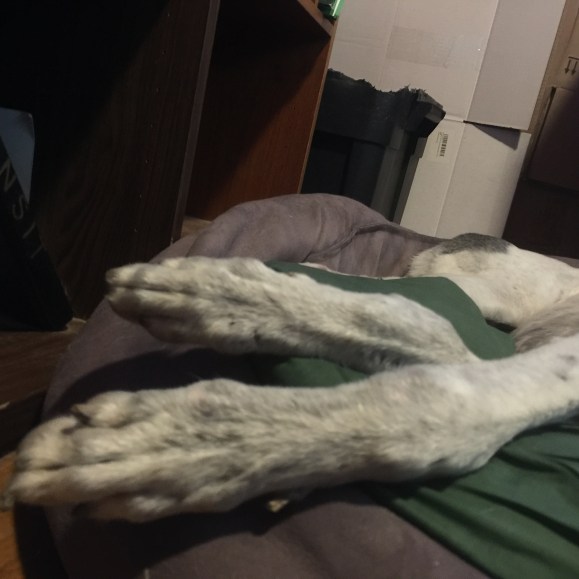
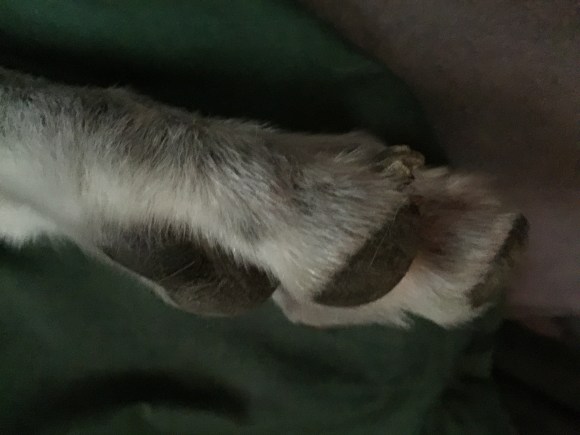
This fore-paw photo looks largely unremarkable. But to the trained eye, it says SLO. The primary indications are a nail grown in a J with the bend parallel to the ground when standing and the stubby nails that looks like a carpenters pencil sharpened with a dull knife and the dull rough feeling horny covering. And from above

IMG_2371

Contrast this with healthy nails on Missy.

IMG_2362

Confirming SLO

SLO is confirmed by biopsy. This involves removing the dew claw or another nail to examine the growth plates. Most dermatologists are sufficiently confident of diagnosis by appearance and will treat without a biopsy confirmation. If the condition does not respond to tetracycline and steroids, then a biopsy is indicated.

SLO is an autoimmune disorder

SLO is an autoimmune disorder of the nail growth plates. The nail is actually a specialized bone designed to help with traction and serve as a tool for digging, defense, etc. SLO causes inflammation of the growth plate and poor formation of the nail. The nail is crumbly and weak and the horny covering is poorly attached to the quick. In the early stages, this presents as the nail peeling like a shrimp. The horny covering separates from the quick yet is attached at the growth plate. The separation is very uncomfortable and will usually result in a limp and possibly some minor bleeding.

As the disease continues, the nail sheaths (skin from which the nail emerges) can become swollen and infected. Most owners notice something is amiss long before this point and seek treatment.

Initial Treatment

Doctor Cook started Nick on a course of oral steroids and tetracycline. He also prescribed topical steroid (Synotic) to apply to the nail growth area at the knuckle. Doctor Cook also started Nick on Vitamin E (400 IU), niacinamide, and fish oil. I was to give the fish oil 180 mg EPA per 10 pounds of greyhound.

Your dermatologist will prescribe the dosage rates for the niacinamide and fish oil and leave you to calculate the proper amounts for the products you are using. It is important to give the fish oil at the proper rate to get the dosage he recommends. Excessive fish oil adversely affects blood clotting. Do the math.

Your vet will prescribe initial treatment based on the assessment of the hound’s condition.

Maintenance

SLO is an autoimmune disorder. It is not cured, just managed. The initial treatment with tetracycline and steroids brings the inflammation under control quickly to restore comfort. Continued treatment with niacinamide, fish oil, and Vitamin E manages the condition long term.

One issue I encountered was that I had misplaced my vet’s instructions and treatment began to drift.

Reference 2 gives dosages for a typical 60 pound greyhound.

  • EPA 180 mg per 1o pounds of greyhound (5 kg)
  • 500 mg nicainamine every 8 hours
  • 400 IU Vitamin E every 12 hours

The combination is synergistic so both the fish oil and the niacinamide must be given to maintain relief. The Vitamin E replaces E lost to fish oil metabolism. Some fish oils are supplemented with Vitamin E so don’t double up if you give a fish oil with a stated Vitamin E potency.

Not all Vitamin B are equal

Niacinamide is one of the many forms of vitamin B manufactured. Get this one. Not niacin, nor the non-flushing alternative. The body converts each of the three into Vitamin B but the but each has different secondary effects. Only nicinamide has the correct internal therapeutic action though all 3 will prevent deficiency diseases.

Niacinamide plus tetracycline is as effective as oral steroids in the initial treatment of several inflammatory diseases and its low toxicity and lack of side effects makes naicinamide preferred for maintenance. I give Nick 500 mg once or twice a day with peanut butter. Based on my reading today, I need to be careful to give 2 or 3 doses a day. It has a strong taste and is uncoated so pill with peanut butter.

Niacinamide is available over the counter in the US by special order from Target and CVS. A bottle of 90 or 100 tablets is about $5 so I buy in lots of 5 bottles to make it worth while. This usually lasts about a year. It can also be ordered from Amazon. Be careful that your supplier doesn’t don’t substitute on you.

The first year

If you give the fish oil at the proper dosage, the nails should show improvement over the first three months of treatment. It took me a good bit of fiddling around to begin to use bulk oil and to give an adequate amount.

Initial treatment brought improved comfort for Nick but his nails continued to peel while I learned to get the Synotic in the right place and tried various forms of oil. I had been getting capsules from the vet and giving 4 grams of oil a day. That was too little. We continued to treat a peeled nail every month or two.

After a bit, the vet decided that it was easy to get oil out in town and stopped carrying the oil capsules. I picked up some Verus coat supplement from my food dealer and began giving it. Over a couple of months, the splitting decreased while continuing the Synotic, E, and B with the oil.

The Verus oil was derived from Flax seed and was low in EPA and DHA relative to fish oil so I looked for a cold water fish oil to give in its place. I found two that are available in the US, Sea Pet and Alaska Natural. The oil that you give should have a statement like

  • provides 775 mg of EPA, 520 mg DHA and 200 IUs (134mg) of natural form vitamin E with each teaspoon.

that allows you to calculate the proper amount of oil to give. For 70 pound Nick, the dosage of this product works out to 1.6 teaspoons or 2 teaspoons. I’ve used both but tend to buy the Alaska Natural which is about $32/quart from my pet food dealer. The product comes in a thick hard plastic bottle with a 1/2 teaspoon pump. The Sea Pet product comes in a lighter soda plastic bottle without a pump. Both should be refrigerated once you start to use them to retard oxidation.

Sea Pet offers the cold water fish oil in three grades, regular oil, and two oils that have elevated levels of EPA and DHA. These sell at a significant premium proportional to the increased DHA/EPA level but the dosage is lower so they work out similarly cost wise per treatment. If you are experiencing sloppy stools, the more concentrated oil will help with that while still providing adequate levels of EPA and DHA. The Sea Pet products are available locally in the Virginia Tidewater and are easily mail ordered from the usual suspects.

After switching from fish oil capsules

Several months after I began giving bulk oil in the chow Nick experienced a reduced rate of nail splitting. The initial improvement occurred with the flax based oil but the best improvement came with the switch to salmon oil. For the two years that I’ve been giving salmon oil, the split nail rate showed a big drop. Nick is getting about 1 teaspoon of oil per 10 pounds of Nick, maybe a bit more. I had been putting 8 pumps or 4 tsp on a ration. Over time, the amount crept up. Having found Reference 2 and doing the math, I can reduce this to 3 pumps per ration.

Nick likes the salmon oil and won’t eat until I’ve put oil in his ration. He goes to the fridge and barks when time to be fed. He associated the oil with dinner and barks at the fridge rather than at the coat close where the food bin is. So I guess he likes it. It’s definitely a better deal than gelcap in peanut butter.

Four years on

Nick still has SLO. It’s an autoimmune disorder, but his is managed and he is comfortable. Peeled nails are rare but his nails are still dodgy as indicated by the crumbly ends. But the horny covering is smoother and is well attached to the quick. Splitting or peeling is rare because they are short and nail quality is improved. Nick is not not reactive to having his nails wiggled and prodded but he’s a grump about it and will tell me off if I’m overly poky about it.

One nail refuses to grow straight and has a rough porous feeling covering. the others are straight with blunt ends. Normal nails are like a machine sharpened pencil with a slick covering. So his are not normal but he is comfortable and his disease is well controlled.

Fish Oil and Clotting

Nick was due for dentistry about a year ago. In preparation, the vet ran a clotting time as part of Nick’s annual blood work. And found it slow. She prescribed Vitamin K treatment and did another draw. Nick was in spec. We scheduled surgery. They did a draw that morning and he was out of spec. So we did a second round of K and did the surgery immediately at the end of the course of K. Success. And he needed no extractions. Go figure.

I was reading another blog about SLO and discovered that fish oil (DHA and EPA) adversely affects clotting time. Nothing to be concerned about regarding every day nicks and scrapes but of concern when surgery is scheduled. The long and short of it is to consult with the dermatologist whenever surgery is planned as the fish oil is an important factor in the ongoing management of SLO. And to alert the vet when emergency care is needed.

Reference [1] mentions the clotting problem also and cautions against exceeding the recommended dosage for that reason.

Categories
Audio

Hi Fi Updates

Last spring, I boxed up the stereo and put it in storage for the duration of the lounge remodel. When I unboxed it and powered up the system, my trusty Conrad Johnson PV1 preamp failed. After considering its age, accumulated problems, and the technical evolution occurring since I had bought it in 1980, I elected to replace rather than to repair.

Categories
Eating Exercise

A Makeover for Dave

I’m a retired moocher who’s become annoyed with the increasing aches that come as one goes out of warrantee. That, and I’m trying to hold Homer Simpson’s Big Blue Pants and the sawbones at bay. To that end, I resumed lifting weights about a year ago and have revised my diet. In the spring of 2015, I dropped 10 pounds as the vernal equinox approached. In the fall, they all came back as the autumnal equinox approached. It could be a seasonal thing or it could be the fall candy corn crop.

There’s a lot written for training high school and college athletes but not much for training retired moochers. The 17 year old trainee is still under warrantee and and still growing. Almost anything works. The 60 year old trainee is most likely returning to training with different goals aimed more at quality of life and remaining active than athletic performance or appearance. And the 60 year old trainee is in need of an overhaul so a soft start and systematic training protocols are important to success.

Categories
Economics

Individual Income in the US

This article came about as a result of watching the Democratic Presidential Debate last Thursday. Senator Sanders and others rail about income inequality in the United States. Their chief complaint is that the rich are sucking up all the money in the country while middle class incomes are stagnant. Senator Sanders offers this problem, probably without any understanding of how income is actually distributed or what it costs to live in the US. In this post, I’ll look briefly at these two topics.

To this point, The Moocher is unaware of any specific proposal to curtail wealth accumulation by the upper extreme of the income distribution.

Revision History

I revised this article to describe the relationship between income density and income distribution and to attribute and describe the social classes used later in the article. I also added the statement that Senator Saunders had not proposed a way to address income inequality.

The Key Points to Take Away

The basic thesis of this article is that the real problem is not that there are statistical tranches of income or that increasing income and inheritance taxes on those earning more than $1,000,000/year will not, by itself, change the fundamental structure of the economy. The problem is that those at the bottom of the economy, about the bottom half of individual incomes are just getting by or struggling. In this structure, the cost of a basic standard of living is out of reach of over 25% of our population, our underclass and our working poor.

If you use the numbers at the end of this post to estimate an income for a 2 adult, 2 child, stay at home mom household, you get a value of $70,000 for a secure income with recommended savings rates. Reference [1] shows that the 2012 median household income was $62,000 so less than half of our households meet this standard.

Our economy is an emergent phenomenon resulting from literally trillions of decisions occurring each day. Our affordability trap results from the way these choices fit together, it is an emergent property that results from all of the trade flows in our economy, particularly those influencing the cost of housing, health care, transportation, food, and energy.

I think we will be hard-pressed to find one simple lever to move to fix the personal income/cost of living mismatch. These flows are continually changing in response to new means of production, new desirable goods and commodity costs.

Structural changes (increasing manufacturing automation  and clerical task automation) are reducing the number of jobs that yield a working class and middle class incomes . This is largely responsible for the erosion in middle class jobs.

Big C Communism’s attempts to have a centrally planned economy, i.e. to control these emergent phenomena, were a miserable failure. Communism created artificial shortages and excesses as a result of the inability to predict the proper flows of goods and services while attempting to control them. I don’t expect that the US Congress will do any better. The problem is just too complex.

References

This article wouldn’t be pseudo-scholarly without references so here are a couple.

  1. http://politicalcalculations.blogspot.com/2013/09/what-is-your-us-income-percentile.html#.VsIlxDauDNQ
  2. https://en.wikipedia.org/wiki/Standard_of_living_in_the_United_States

A bit about statistics

Statistics offer one way to make sense of your income. Where are you ranked in the total US population of incomes? There’s you, those who make less, and those who make more. Reference 1 shows the cumulative income distributions and has a calculator that will figure out your place in this spread.

Their figure 1 shows the total US income summed up from zero to $1,000,000. Your doctors and dentists are in the $200,000 to $400,000 range so this figure includes them but it excludes entertainers, paid athletes, and corporate and hedge fund executives. But it does catch about 96% of the country’s population. Those lofty folk not included account for 4% of the population.

Where the data comes from

The US Census has several sources of data. First it conducts annual surveys. Second, the Internal Revenue Service makes anonymous income data sets available to other agencies, researchers, actuaries, and such. The data used in Reference 1 is very reliable.

The standard of living results appearing in Reference 2 are also taken from Bureau of Labor Statistics and Census Bureau compilations of results. These too are reliable. The thresholds I cite at the end are from memory and, look as I might, I’ve not been able to find a source for them. But they do square with Reference 2.

Average and Median

The figure is plotted on a semi-logarithmic scale. Researchers and engineers use this plot when one of the variables has a large range and the other has a small range. In this case the Y-axis is percent of total income. The X-axis is the log of individual income. So the vertical axis is “natural” while the horizontal axis is “compressed” to fit on the page.

Those looking at the reference will see that US individual median income is $27,000. I’ll come back to this.

If you look at the plot, you see two horizontal lines that mark the median income and  the average income. The median income is that mythical income that divides the population into two equal parts. Half make less while half make more. The average income is the total income divided by the number of recipients. These two are different with the median lower than the average. This happens when the distribution is skewed with significantly more of the samples being less than the average value than greater than the average.

The lazy-S curve is what statisticians call a cumulative distribution function. The number plotted at each income level is the total percentage of income samples up to that point. In this plot the curve shows the percent of total samples, not the total income. That curve would have a similar shape but would be plotted log-log and is difficult to interpret. To give an example of how the curve works lets consider a couple of ideal cases.

  • Everybody makes $10,000. The plot would show zero up to $9999. At $10,000 it would step to 100%.
  • In reality, US income distribution has the shape shown that reflects a most common individual income near $25,000. It rises sharply to the peak and trails off more slowly with a long tail at between your dentist and your favorite corporate CEO. The cumulative distribution continues to rise because the total number of incomes is continually increasing from the start of the dataset to the end of the dataset.
  • The curve is steep where there are lots of samples and relatively flat where there are few samples, that is at the left and the right ends. The steeper the curve, the more samples in that slice. That gives the S-curve shown. The slope of the curve is the percent of incomes at that level (the value of the slope vs income is the income density curve. The income distribution curve is the integral of the density curve.)

Percentiles

Statisticians often divide groups into subgroups. One of the most common techniques for expressing this division is to talk of percentile levels. Median income is the 50th percentile income, half make more while half make less. 90th percentile income is that amount at which 90% make less and 10% make more. 99th percentile income is that point at which 99% make less and 1% make more.

The funny thing about statistics, is, that no matter what you do, 50th, 90th, and 99th percentile incomes will always exists. That’s simply statistics. Being on one side or the other implies nothing about your character, your hard work, or anything else. That’s just where you are in the 300 million of us.

Class Income Levels

Looking at Dennis Gilbert’s class model in Reference [2], about half of our population are in our working class, working poor, and underclass. From the tables, our working class are about 25% of the population. They have safe housing, adequate diet, and reliable transportation to work but are unable to save significantly. The working poor and the underclass together are about 25% of the population. About 1/8 of us are working poor living in compromised housing, nursing a failing vehicle for transportation, and daily life is a struggle. About 1/8 of us are under class unable to work regularly or unable to work.

The researchers cited in Reference [2] use living conditions, not income level to determine the numbers in the working class, working poor, and underclass. In his model, the underclass are not self-supporting, the working poor have high economic insecurity and risk of poverty. The working class are just scraping by with adequate housing, food, and health care but with limited savings It is coincidence that these levels extend up to the $27,000 median individual income level. The real tragedy is that 1/4 are just getting by, 1/8 are struggling financially and 1/8 are living in serious poverty and 1/4 are unable to save for retirement.

Income Thresholds

A few years ago, I heard an NPR story that gave these income thresholds.

  • $30,000 provides basic subsistence
  • $40,000 allows some saving for retirement and misfortune
  • $10,000 additional is required for each additional dependent sharing a household

The $30,000 provided safe housing, diet, and basic health care and transportation to support travel to and from work. There were no luxuries. The additional $10,000 allows saving for retirement and emergencies. The third amount is the marginal amount needed to add a child or a stay at home adult to the household. It covered the marginal costs associated with the added individual.

A family of 4 with a secure standard of living requires $70,000 in income from one or two wage earners.

The striking fact that stands out in my mind is that half of us earn too little to live independently at a basic standard of living. This is the real problem with income inequality: that 50% of us earn too little to live independently.

Categories
Recipes

Southern Chicken Bog

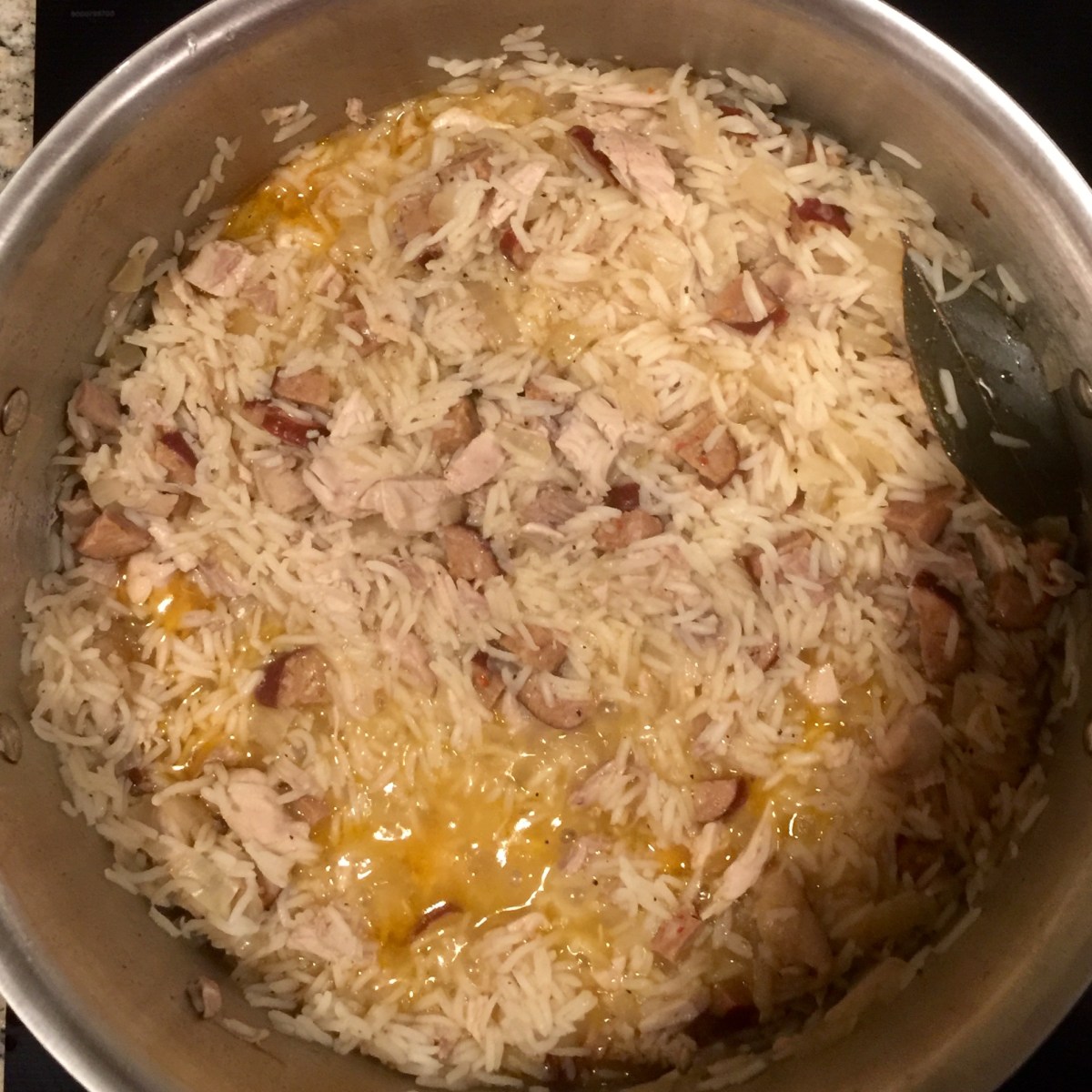
Luke Murden, Whole Foods Cooking Coach, demoed this recipie in the summer of 2015. It is quite tasty so I kept it until I had an urge to go off the vegetarian reservation for a while. With 3 batches of Food52 Lentils and Sausage soup left, it seemed like a good time to make this classic.

I suspect that this recipe is good with brown Basmati rice but I recommend making it first with white rice as directed. The change to brown rice requires adjusting the cooking liquid up. Luke’s recipe is for 3 rice to 8 liquid. The normal white rice ratio is 1 to 2. The normal brown rice ratio is 1 to 3. The process of cooking the chicken may reduce the water some. Then again, there may be a reason this is called chicken bog. I don’t recall it being soupy as Luke made the demo in the pressure cooker and halves the liquid for this method.

This recipie is for 4 omnivor servings. To serve 8, double everything. I made mine with a whole softball sized sweet onion. Onion is good.

A 6 quart Dutch oven should hold either 4 or 8 servings. I made 4 so I wouldn’t be awash in leftovers.

Servings and Macronutrients

This recipe makes 4 to 5 servings of about 1 pint. I used UnderArmor’s My Fitness Pal to calculate the macronutrient analysis. Although the salt number is high, the dish did not taste salty.

Those concerned about salt can skip the Better Than Bouillon which is quite salty. The dish is fine without it as I discovered by accident.

Those concerned about fat can reduce the fat by removing the chicken skins before cooking. I’d recommend using the butter as directed. And do use real butter as it is trans-fat free.

  • 855 Calories
  • 37 grams fat
  • 70 grams carbohydrates
  • 55 grams protein
  • 1700 mg salt
  • 470 mg potassium

Ingredients

This list of ingredients is 1/2 that of Luke’s original recipe to feed 8. You can go long on the onion but observe the meat and rice amounts and liquid

  • 4 chicken thighs, 1 per serving
  • 1/2 pound (1/8 pound per serving) of smoked sausage
  • 1/2 cup of chopped onion
  • 1/4 cup butter
  • 4 cups chicken stock (I use Better Than Boullion)
  • 1 1/2 cups white rice

Spices

This spice list makes 4 servings

  • 1 teaspoon salt
  • 1/2 teaspoon black pepper
  • 1/2 teaspoon ground red pepper
  • 3 bay leaves

Preparation

this recipe does not have a sauté step. I don’t believe it would hurt to sauté the onion, brown the chicken, and brown the sausage. If you do, do these processes in the Dutch oven using olive oil as needed.

  1. Dice the onion
  2. Dice the sausage into 1 cm pieces
  3. In a stock pot or 6 quart Dutch oven add the water chicken, sausage, onion, butter, and seasonings. Cover the pot and bring to a low boil for 40 minutes.
  4. Remove the chicken, let it cool, and pull it from the bones. Chop to 1-2 cm length if needed.
  5. Discard the chicken bones and skin.
  6. Add the rice to the pot, cover, and return to a boil for 10 minutes.
  7. Reduce the heat and simmer until the rice is done. Maybe 10 more minutes for white rice
  8. Remove the bay leaves and fluff the rice using a fork. Stirring will make the rice gummy which is not Southern!
  9. Return the chicken to the pot. Fiddle with the salt and pepper to taste.

Serve with your favorite adult beverage. I think a red wine would be best given the lavish amount of butter in this brew. A good malty or hoppy beer should work well also.

Review

Southern Chicken Bog proved easy to prepare following the directions above. In my preparation, I forgot to add the chicken Better Than Bouillon but the end result was still pretty tasty. It is important to use a smoked sausage as the smoky flavor makes the dish distinct. Serve with two vegetables and red wine or a hoppy beer.

Categories
My blog

Blog Makeover

While porting ucnorfolk.org to WordPress, I learned about WordPress short codes. Short codes are magic strings that cause WordPress to insert content in a post or page.

References

  1. https://en.support.wordpress.com/shortcodes/

Motivation

As I began writing the blog, I had a bit of a dilemma: where did I put something? If it was a blog post, it disappeared into the archive after a few posts. If I made a page, the material never appeared on the front page. I encountered this first when I decided to torment my aunts with the Yankee Greens recipe. I needed to keep it around so I could make it again.

WordPress offers a solution

You can assign a post to a category. WordPress can retrieve posts by category. There’s a widget for that in the primary sidebar to the left. But did you know that WordPress can insert stuff into posts for you? Well, It can.

WordPress short codes let you do this. Short codes are magic strings inside square brackets that tell a WordPress plugin to do something for you. One of the things it can do is display posts that match a criterion like “Category”. Interestingly, I had been assigning my posts to categories.

WordPress plugins make short codes available. With luck, the plugin’s documentation describes the short codes that it offers and explains how to use each. The WordPress.com reference provides a list of of short codes available in a WordPress.com site with links to the user instructions for short code.

The display posts short code plugin causes WordPress to retrieve a list of posts by category that it inserts into the post or page. Short code arguments tell the display posts plugin what to retrieve, how many to retrieve, and how to format the results. Problem solved. Write a page that pulls post excerpts by category. Now I had a page with abstracts of each post assigned to the category.

Other short codes let you interact with Facebook, Twitter, YouTube, and others. You can have a lot of fun amazing your friends with creative use of short codes in pages, posts, and text widgets.

New Navigation

As I began making new top level pages for each category I wanted to feature, I discovered that I had way too many of them for the main menu. So I made a page about the Moocher’s interests and made the category pages subpages of it. Now folks can find stuff I think is important that I’ve buried in the the compost heap of the blog.

Categories
My blog

Blogs I follow

This New Years Day I decided that I should list some of the blogs that I follow on my blog. The list is somewhat eclectic including some interest blogs and some friends.

Blue Virginia

Blue Virginia is a blog about Virginia politics written from a democratic or progressive point of view. It is a good source of news about the doings of the Virginia Commonwealth legislature and the state officers. This blog does not have many kind words for the Virginia Republican Party or the national Republican Party. Sorry about that.

Energy From Thorium

Kirk Sorensen, former NASA engineer working on power systems for space exploration, writes this blog. Kirk Sorensen is an engaging speaker and an engineer’s engineer. He left NASA to form FLIBE Energy, a start-up company working on development of the thorium fuel cycle and molten salt liquid fuel reactor development.

This is an important future energy technology that can be taken commercial over the next decade. Because the fuel is molten, the reactor has already had a meltdown. It is designed to work that way. Because molten salts are extremely stable, there is no danger of a fire or other processes that would disperse spilled fuel. And because of the choice of fuel, U233, no bomb suitable isotopes are formed and the reactor transmutes long lived isotopes. Spent LFTR fuel need be stored for only 100 years or so for radiation to decay to background levels.

Dick and Libby

Dick and Libby Mills are retired friends cruising the US east coast, Great Lakes, St Lawrence Seaway, and US Gulf coast. Dick is a former power engineer holding key patents for overspeed protection of utility scale steam turbine generators. Dick was also a pioneering developer of nuclear power plant operator training simulators working on the Dresden I simulator while at GE. Dick’s last gig before retiring was as energy management system manager for the New York Power Authority, the New York State independent system operator responsible for distributing electric power within the state.

Adrenaline Racing

A fraternity brother (50-ish) is a world class dingy sailor ranked in International 14 boats. Kirk competes at the national level and is ranked in the top 20 or so sailors in the class. In 2014 he and some mates bought Adrenaline, refitted her, learned to sail off shore, learned race planning, and raced the boat in the 2015 Transpac. The blog is about their adventures in the 2015 race.

Bella and Friends

Samantha Whiting in Banbury, Oxfordshire, UK — the middle kingdom, writes this blog from the point of view of Sam’s BellaBob, her greyhound. Sam does a good job — keeping it simple, staying in character (mostly), and never lapses into bad dialect. Great fun teasing BB on Facebook where she has a pet page. BellaBob is famous for her doggerel. And silly selfies. And Charlie the Yorkie Terrier and Miffy the scratchy cat.