
Revisions
- 2025-12-02 Original
- 2025-12-03 Simpler title, add categories, correct the led, and explained aux heat. Added Alec Watson’s “Untapped Energy Storage” YouTube presentation
References
- https://www.energy.gov/energysaver/programmable-thermostats
- https://www.dominionenergy.com/virginia/rates-and-tariffs/off-peak-plan
- Example whole building Manual J calculator by Service Titan
- https://www.ashrae.org/technical-resources/ashrae-standards-and-guidelines
- https://www.publicpower.org/system/files/documents/Americas-Electricity-Generation-Capacity-2025-Update.pdf
- https://en.wikipedia.org/wiki/Duck_curve
- Technology Connections YouTube: Untapped Energy Storage
- https://en.wikipedia.org/wiki/Reluctance_motor
Energy Star
During the Carter administration (1977-1981), Congress created the Department of Energy composed of the nuclear weapons program and associated national laboratories full of smart people. The DOE was also tasked with development of new energy conversion and utilization technologies and with energy conservation technologies and recommendations.
The 1970’s OPEC oil embargo was a driving force in the establishment of DOE, the Energy Star program, and its recommendations. During this period Congress established automobile emissions and efficiency regulations and the Energy Star residential energy efficiency program.
During this period, Energy Star recommended a day time heating set point of 68 degrees (suspiciously like some physicist picked 20C) and a night time setback of 10 degrees. These recommendations were global rather than regional and ignored the type of heating equipment present.
A little physics, just a little
I’m a former electrical engineer and submarine nuclear propulsion plant operator. My school and Navy nuclear propulsion insisted that we learn about heat transfer.
Two primary mechanisms dominate heat loss from a structure, air leakage between the building interior and the environment, and heat conduction through the building envelope.
(1) Qdot = UA(Thot – Tcold)
Equation 1 shows that the heat transfer rate Qdot is proportional to the temperature difference between the building interior and the building environment. Here we assume that cold is outdoors and warm is indoors. The factor UA describes the building’s surface area and how easily heat passes through the stuff from which the building envelope is made. UA is a property of the building
A little climatology, just a little
Heating and cooling systems are designed to maintain control of the building’s interior temperature during 99 percent of the hours in a year. Each county in the US has a design basis winter heating ambient temperature and a cooling ambient temperature. Here in Norfolk, these temperatures are about 25F for heating and 95F for cooling. I’ll stick to Fahrenheit temperature here since that’s what we normally talk in this country. These days, we do most of our design in international standard units which include Celsius temperature.
The NOAA climate researchers determine the county design basis temperatures from their collected climate datasets. They search the dataset for the coldest hourly temperature for each of 50 years. They average these, and that becomes the number. They do the same with the hottest hourly temperature to get the cooling design basis temperature.
Climate and Physics Mash-up

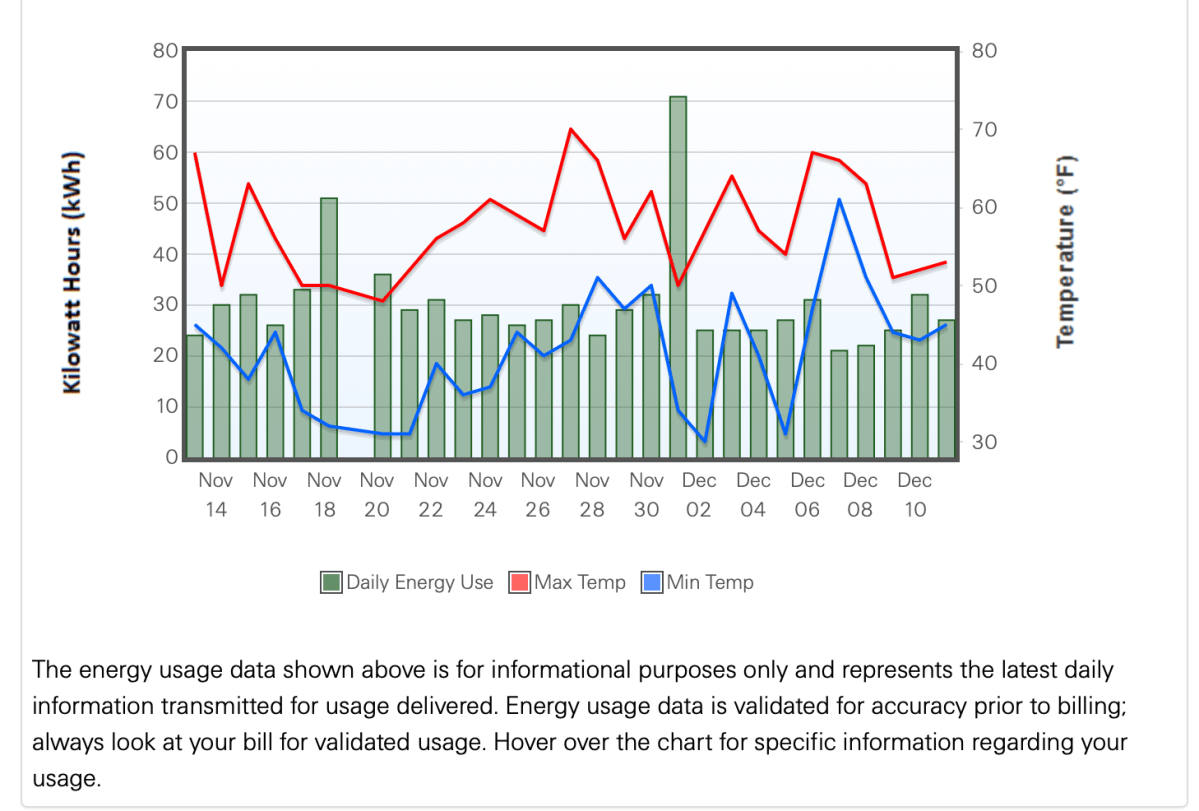
If you look at the graphs above, you’ll see the year’s usage for Dismal Manor. November is the least usage month in both 2024 and 2025. That’s a bit of a surprise.
Dismal Manor used about 720 kilowatt-hours of energy for all purposes including laundry drying and dish washing, and 30 KwHr charging the car in November. The hi-fi and small computers were also running. During this period, heat losses from internal stuff supplied most of our heating needs. Looking at the graph, July was our month of greatest use. Two lines show the monthly average low and high temperatures.
In July, the typical outdoor high temperature was 95 degrees, the cooling design basis. If we keep a 75 degree indoor temperature, the heat pump has to maintain a 20 degree differential temperature. To do that used about 600 kilowatt-hours of electrical energy.
Fiddling with the set point
What happens if I raise the set point from 75 to 76? I’ve reduced the temperature difference driving heat gain from the environment by 1 degree. That’s also 1/20 the temperature difference driving conduction through the building walls. That suggests that about 5 percent less energy will be gained from the environment if a day were 95 F outside continuously.
In Norfolk, the morning low temperature is 75F in July but the variation is not uniform. And, in July, we have a hot Southern sun beating down on parts of the house. In November, the late afternoon sun slips under the trees warming the building from the west. The Energy Star recommendations neglect solar heating of the structure.
Sensible Heat and Latent Heat
The air in the building holds energy. There’s an equation for that too.
(2) Q = M Cp (Thot – TCold)
Equation 2 tells us that the heat to warm or cool the air in the building can be estimated from its mass, a constant pressure heat capacity, and the temperature change. The same model holds for all the other stuff in and of the building. An effective Cp can be estimated from temperature change and bulk energy usage.
But the air in the building is a mixture of gases and water vapor. The water vapor is condensible. The air-conditioning process removes it. The rest of the stuff stays. To get the water out of the air, we have to remove its latent heat of vaporization from the air. And this has to happen before the air gases themselves are cooled.
So to cool the air in the building, we have to do both. Removing the heat associated with the humidity is the harder of the two tasks.
My Summer Practice
I adjust the air conditioning set point to keep the building humidity in the 50% to 60% range. For my home in beautiful Norfolk, I find 77F is a good summer setting.
If I do an Energy Star set up over night, I awaken to a clammy building. The air conditioning needs to work through the night to control humid air infiltration.
Heat Pumps and Electrification
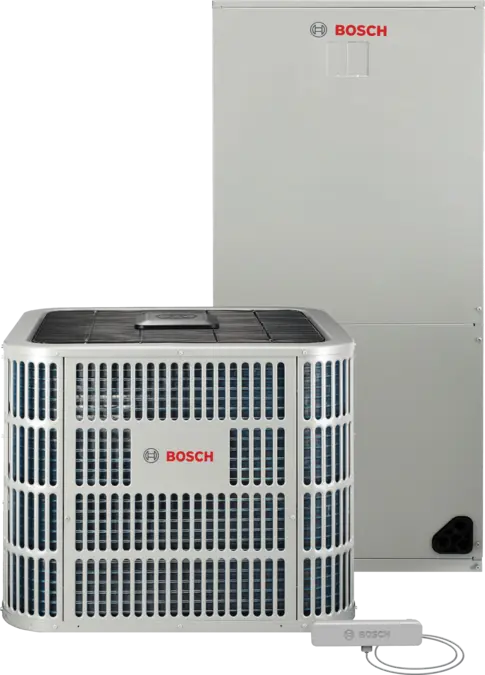
A heat pump is a refrigeration machine that moves heat from cool to warm using a condensible gas and a compressor. The gas is compressed and condensed at the hot end and expanded at the cool end. In a refrigeration machine designed for cooling only, the evaporator is indoors and the condenser is outdoors. When the liquid evaporates in the indoor unit, it takes heat out of the air passing through the indoor coils. Outside, it gives up heat to the air passing through the outdoor coils.
A heat pump is a refrigeration machine having some valves and smarts to reverse the roles of the two heat exchangers. When heating, the evaporation process happens outdoors and the condensing process happens indoors.
So a heat pump moves heat rather than releasing heat by combustion of a fuel. A carefully designed heat pump can move 3 times the energy put into the compressor (the pump that raises pressure of the working fluid so it will condense).
In heating mode, a dollar in gives $4 of heat out. Put a dollar of gas into a gas furnace and you get $0.96 of heat (a small loss instead of a big gain).
The catch is that the cost of 1 KwHr of natural gas is 1/4 of the cost of 1 KwHr of electric power. But it is actually more efficient to let Dominion Virginia Energy burn the gas and transmit electric power to you to run your heat pump.
Several factors are at play here. Dominion buys gas whole sale on long term contracts. Dominion burns the gas in combined cycle gas and steam turbine power plants. One KwHr of gas yields 1/2 KwHr of electricity. Your heat pump will schlep 2 KwHr of heat.
Increasingly, photovoltaics and offshore wind are replacing older fossil fuel units and providing expansion capacity. As renewables come to dominate the generation mix, home heating will become largely carbon dioxide free.
But won’t I shiver on cold days?
Temperature is an absolute thing. It has to do with molecules in motion. If they are completely still, the temperature is absolute zero. Until absolute zero there’s heat to be had. There’s a scale for absolute temperature, Kelvin temperature, the one scientists use. We use a related scale, Celsius that has 0 C at the freezing point of water and 100 C at the boiling point of water at sea level atmospheric pressure. But Kelvin degrees and Celsius degrees are the same size.
Below 0 Celsius, air molecules are still moving and still have energy that can be moved up hill to heat your home. The stuff intuit is air condenses at about -271 Celsius.
The tricky bit is that the working fluid, the refrigerant, in the heat pump needs to boil in the evaporator at a temperature below the coldest outdoor temperature with which it will be used for heating. So we pick our refrigerants to have a boiling point below the cold side rated temperature in winter.
Energy Star provided grant money to each participating domestic manufacturer to develop cold climate machines and certifies all manufacturer’s machines as meeting the Energy Star Cold Climate standard.
Sizing Heat Pumps
There are national and international standards for sizing heat pumps used for space heating and cooling. In the US, an industry consortium develops the standard and our building codes mandate its use. This standard provides models and data (Manual J) for estimating the heating and cooling needs of each space in a building and includes county by county design basis temperatures for heating and cooling.
In Norfolk. heating is the harder of the two problems. In heating mode, the heat pump has to deliver the heat lost by the building with a 45 degree temperature difference (25F to 70F) present. In cooling mode, the temperature difference is about 1/2 that (75 F to 95 F).
To keep the building warm on that 1% of hours that are colder than 25F, our installation includes auxiliary heat (aux heat). This is a bank of positive temperature coefficient electrical resistance heaters rated at 5KW.
Variable Speed and Staging
Inexpensive digital signal processors and power transistors make it cost effective to replace fixed speed induction motors with variable speed synchronous reluctance motors [8]. This has several advantages.
- The heat pump runs at the speed needed to match the heat gain or loss being made up.
- The heat pump has sensors that determine the thermodynamic conditions present. Based on models of the machine and sensor readings, the machine controls determine the compressor and fan speeds to be used.
- The compressor motor drive soft starts the compressor. The inverter ramps up the voltage and frequency to gently roll off the motor and accelerate it to the needed operating point. Bosch does this so well that the machine start is silent and fan noise is not initially noticeable.
- My machine has an unloader valve that recirculates refrigerant around the compressor while it starts. As the machine comes to speed, the unloader valve closes gently loading the machine in a manner that is easy on the mechanism and Dominion Virginia power.
- The indoor and outdoor fans are variable speed with soft starting. The fans run at one of 10 preselected speeds. The indoor fans are speed controlled to give the proper refrigerant outlet conditions for the load present.
My Smart Thermostat’s Role
My contractor installed and configured the Ecobee Premium thermostat controlling the Dismal Manor heat pump. He picked the amount of hysteresis (or dead band) and other technical parameters. My understanding is that the Bosch IDS units control modulation internally.
My smart thermostat has three modes: cool only, cool or heat based on temperature, and heat only. In the transition months, I select the cool or heat mode. In summer and winter, I select the cool mode or the heat mode respectively.
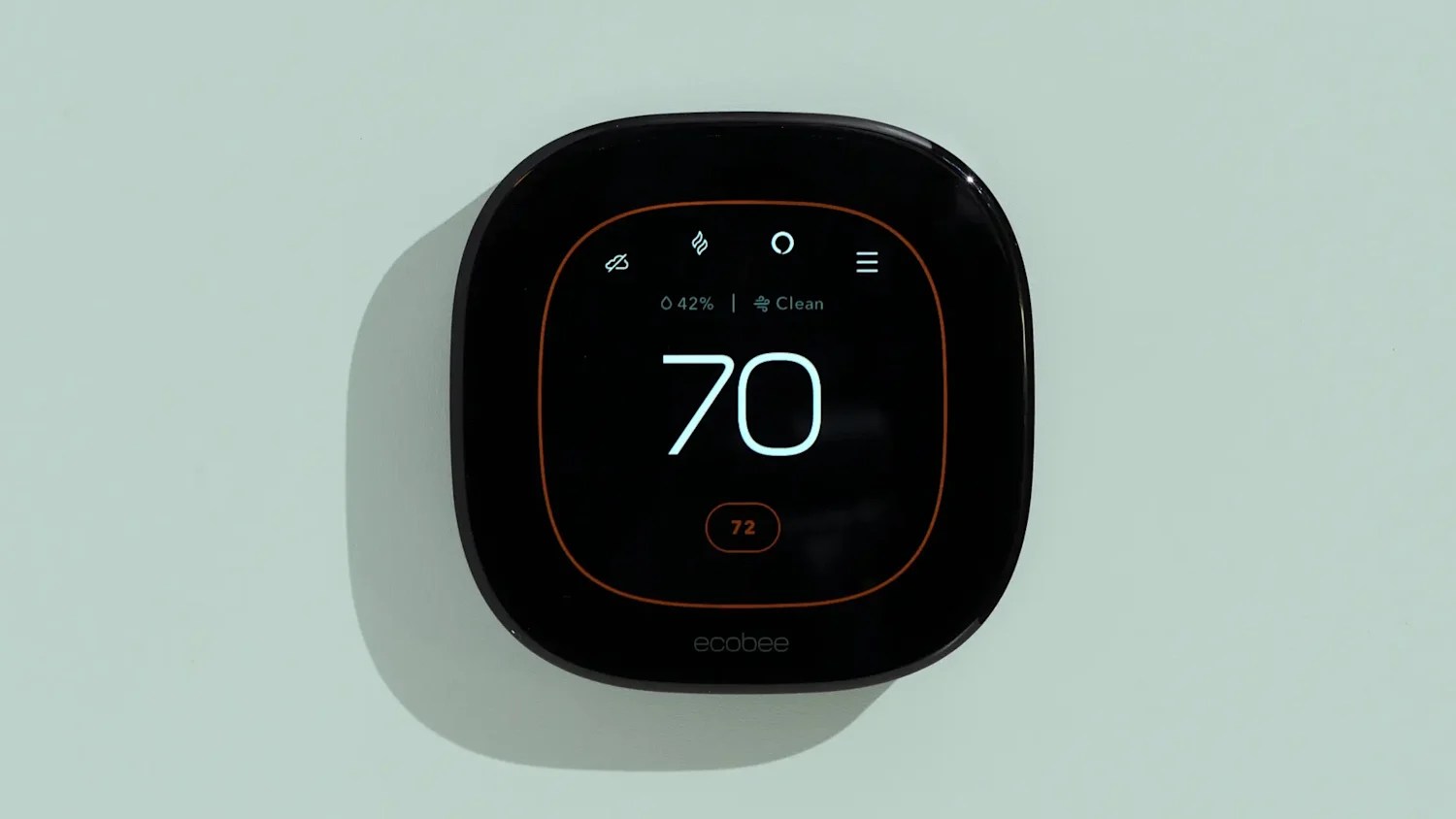
image courtesy of Ecobee
The thermostat has a set point chosen from a time of day map (Ecobee calls these “Comfort Settings”). The thermostat technical configuration settings includes temperature error to start stage 2 and temperature error to start Aux Heat if these are to be used.
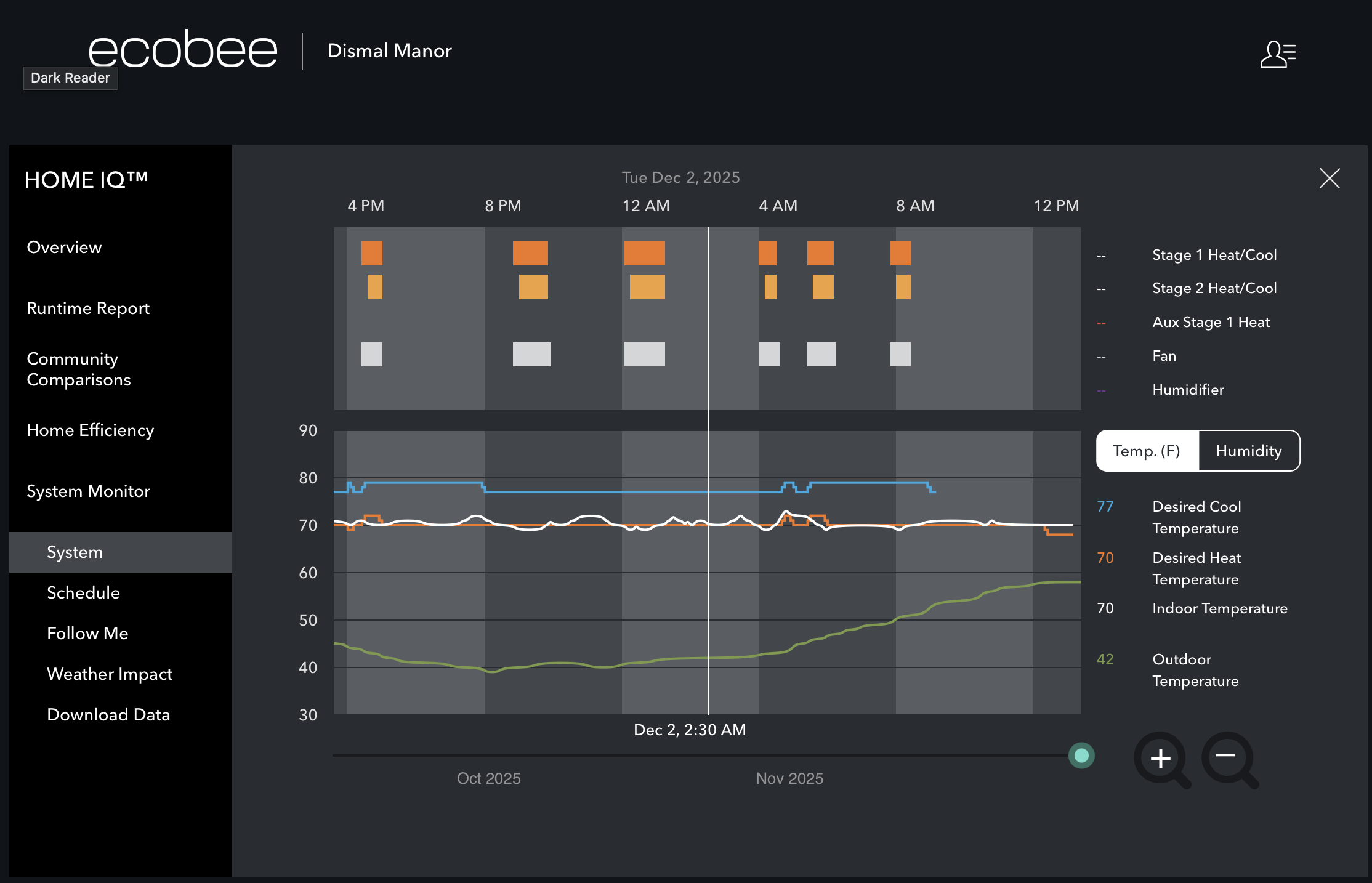
captured here at Dismal Manor
Should the temperature continue to drop, temperature error will exceed the stage 2 set point and eventually the Aux Heat set point.
On the figure
- The blue trace is the cooling set point. The blue trace stops at the point where I shifted the unit to heating-only mode.
- The white trace is the building temperature.
- The orange trace is the heating set point.
- The green trace is the outdoor temperature.
- The darker orange bars are the machine running in stage one heating.
- The lighter orange bars are the machine running in stage two heating.
- The aux heat has not been used — no demand.
Looking at the thermostat data display, you can see the thermostat’s Eco+ demand management scheme. Just before 5 PM, it preconditioned the building for the evening coast period coinciding with the evening peak rate. And just before 5 AM, it preconditioned the building for the morning coast period coinciding with the morning peak rate.
The two orange bars indicate that the thermostat is calling for stage 1 heat and stage 2 heat. The machine starts at minimum demand. As needed, it will modulate output to maintain the building at set point. The machine I just replaced relies on the thermostat to control staging. The new Bosch machine determines staging internally.
The Bosch indoor unit exchanges telemetry with the outdoor unit. The outdoor unit uses that data to select its operating speed and that of the indoor unit.
The outdoor unit also has a WiFi interface that sends telemetry to the manufacturer and my contractor will be notified if the machine is becoming wobbly. The technician can review all of the diagnostic measurements and fault codes before leaving to make a service call.
When the heat pump is no longer able to hold indoor temperature, the indoor unit will turn on the auxiliary heat.
What is this Aux Heat Thing?
My air handler (indoor unit) incudes 5 KW or 17000 BTUS/Hr of positive temperature coefficient electric resistance heaters. PTC heaters increase in electrical resistance as they heat up limiting the flow of electricity through them. This is an important safety thing.
The aux heat has a coefficient of performance of 1. Feed the aux heat $1 of electricity and $1 of heat comes out. Feed the outdoor unit $1 of electricity and it moves $4 of heat to the indoor unit, a coefficient of performance of 4. To save money, the aux heat should almost never come on.
The heat pump controller (the logic is in the indoor unit) activates the aux heat when the heating temperature error (setting minus actual temperature) exceeds the aux heat activation threshold. Before this happens, the controls have increased the compressor speed to maximum and adjusted the indoor and outdoor fan speeds to match. If maximum compressor level of effort is unable to maintain building temperature, the building continues to cool, and the controls add the aux heat output to that of the heat pump giving an additional 17,000 BTU/Hr of output (total of 15 KW or 53,000 BTU/hr).
In the rest of the world, engineers talk KW of heat, only the US heating trade has stuck to tons of ice per hour of cooling and BTU/Hr of heat.
Energy Star Strategy is Obsolete
Don’t follow the Energy Star recommendations. If you make the Energy Star 10 degree night time set point reduction, there is a good chance that the building will cool sufficiently over night that restoration of the day time set point will cause the difference between the set point and the building temperature to exceed the aux heat activation threshold.
The aux heat has no gain (performance coefficient of 1) against the refrigeration machine’s performance coefficient of 3 to 4. Aux heat gives you your money back in heat. The refrigeration machine gives you 3 to 4 times your money’s worth of heat.
To minimize your bill, you never ever want the aux heat to activate as a result of a set point change. Aux heat should activate only on those one or two nights when the temperature is less than design basis (25F here).
That is, air in the building heats and cools the buildings furnishings. They heat and cool more slowly than the air but they heat and cool. Also, the air in the building warms or cools interior finish materials of the building envelope. To get the machine to settle into the steady state, the envelope interior surface materials have to warm. A big setback lets the interior envelope get cold and the heat lost has to be replaced.
Energy Storage in the Building
It is possible to use the building content and building interior materials to store energy. Alec Watson of Technology Connections YouTube channel has tried this heating strategy. He has a video [7] explaining the scheme he uses at home.
What Alec does is to heat his town home during the base rate periods and let the building coast during elevated rate periods. This is very similar to Dominion’s residential demand response strategy. Alec is of hearty mid-western stock so he doesn’t mind it being a bit cool at times. He has a plentiful supply of tweed jackets and cardigans!
Both Heating Machines and Electric Power Generation Have Changed
In 1978, most of our power came from coal fired generation. As 2024 closed, 42% is gas turbine combined cycle, 15% is coal about 8% is from nuclear power, 22% is from photovoltaic solar sources and wind [5], and a smidgen (for Dominion Virginia Energy) is from offshore wind generation. Virginia Offshore Wind will complete in late 2026 but a few turbines are on line now.
Solar generation is strongest midday but drops rapidly after about 3 PM. During this period, summer demand actually increases as people come home, awaken the air conditioning, and fix supper. To keep up with the shift of demand from work to home, Dominion has to start and load its peaking units to replace the fading solar resource.
There are two classes of generation: dispatchable generation and non-dispatch able generation. The output form a dispatchable source can be varied as. needed by the system operator. A non-dispatchable source comes and goes as dictated by physics and the weather. Photovoltaics are largely non-dispatchable. Wind is some dispatchable in that turbines that are not needed now can be feathered. Blade pitch can be controlled to vary output somewhat. But if the unit is becalmed or the wind is too strong or gusty, the unit must be feathered for machine safety and grid stability.
Duck curves [6] represent the amount of dispatched generation the utility must operate to meet the demand in excess of the photovoltaic and wind generation that cannot be dispatched. Utilities use demand management schemes to ease the transition from photovoltaic generation to dispatched thermal generation.
In the winter, there is a period of increased demand in the morning from 6 AM to 9 AM as business demand increases but residential demand remains. And in the winter evenings, there is a period of increased demand from 5 PM to 8 PM when activity shifts from work to home. Dominion’s demand response program is aimed at managing residential heating and cooling demand to somewhat mitigate the demand changes associated with the work day beginning and end.
Dominion Virginia Energy’s contractor follows the calendar and the weather to determine if demand management would be beneficial. If it is, the contractor preconditions the homes of residential participants and adjusts their set point by a degree or two to mitigate residential usage. This works nicely.
Dominion offers Residential Time of Use pricing to go along with the set point adjustments. In the winter, the tariff is as follows.
- 0000- 0500 Base load, $0.12 per KwHr.
- 0600-0900 Morning rush hour, $0.28 per KwHr
- 1700-2000 Evening rush hour, $0.28 per KwHr
- Otherwise $0.13 per KwHr
The summer hours and rates are a bit different. Two rates are used, peak and off-peak. The base load and off peak rates are the same. There is only one peak period from 3 PM to 6 PM.
As you can see from the winter rate schedule, the Energy Star recommendations of an 8-10 F overnight set point are likely to activate the inefficient aux heat during the morning peak pricing period. This is absolutely stupid.



 Dismal Manor Dispatches
You must be logged in to post a comment.