
In October, a Tesla Model Y replaced the ID.4 as my daily driver. Six months after the ID.4’s mishap, VW still can’t tell me when they will have the contactors needed to repair my vehicle. I’m becoming concerned about the battery’s health as it has been in a discharged state for 6 months now. But the things that drove the Model Y order were
- The price cut
- Tesla is a “start-up” integrated manufacturing and retail operation, not a legacy OEM, distributor, and dealers.
- Tesla’s has a can-do attitude, mission, and enthusiasm for the mission.
- The bloody “replacement rental” was costing a car payment. I’d rather have a car payment and an actual car.
Munro Associates on Tesla Model 3 and Y
Cory Steuben, then with Munro Associates, made a telling statement that I’ll paraphrase.
When I talk with friends working at the American OEMs, they talk about their promotion, pay, their careers, but not the cars they build. When I talk with friends at Tesla, they talk about the company, the company’s mission, and the cars they’re working on.
https://www.youtube.com/live/SSP3EDRFlss?si=gOG_Tz8h4esWF_Xw
Apparatchiks versus car guys. I’ll take a car built by car guys and gals any day! The video is Skip and Cory talking with the Autoline After Hours journalists. Skip and Cory talk about Tesla’s spring show and tell for finance types, the things they saw on the factory tour, and the evolution of Tesla design and manufacturing from Model 3 to Model Y as seen in tear-down analysis and the implications for Tesla’s growth and competitors (they’re toast).
Skip Munro and Cory Steuben continually talk about Tesla’s continuous improvement process, running changes on the line, and steady improvement of build quality.
When initially asked to review Model 3, Skip took a look at the haphazard fit and finish and scowled. Hanging out in the lot, he noticed that his engineers who had driven the car were grinning from ear to ear. When the engineers began the tear-down, the simplicity of structure and assembly impressed him. About 4 months later, they received a second car that they compared to the first and noted that significant improvements had been made on the line.
The Model 3 is built from stampings and weldments but Model Y replaced 70 or so stamped parts with die cast aluminum frame castings (“giga-castings”) significantly strengthening Model Y and simplifying building it.
A Model Y has a lower assembly cost than a Model 3 as a result of the optimizations made in the structure, use of giga-castings to eliminate assembly steps, and simplified control area networks and associated wiring harnesses, and a compact spur-line assembled integrated cooling and HVAC system. The HVAC is organized as a multi-zone heat pump system with heat recovery. It can cool the battery and drive while cooling or heating the cabin.
About 43% of Model Y’s cost is in the battery, drive, and cabin and drive cooling.
More Driving Impressions
Tesla’s tuning of the Model-Y accelerator and drive is just amazing. I have the vehicle set to hold position while feet off. When I roll the vehicle off, I can control the creep precisely with just the accelerator. If I want to move the vehicle 3 inches, I can!
The traffic sensing cruise control works pretty well on the motorway but only kind of sort of around town. It will maintain speed pretty well but Tesla has tuned it for open road motoring and not keeping posted speed in a school zone. Coming out of cruise, the car would drop into 1 pedal with the accelerator released and begin a robust slow-down. I didn’t like this behavior. Maybe less coast down for road trips?
First Charge
The Model Y feature to start charging at time T works. I set up the car to commence its first charge Friday midnight and it did. For Saturday’s trip to Richmond, I’ll set it to have the car ready to go at 0830 and it likely will. The dialogs are clean. No table of places identified by mensurated coordinates from the GPS.
Just pick how the next charge should behave. Normally, the car will charge cell phone style if a start time is not set. Start time and completion time are mutually exclusive and independent features. Choose one from column A; there is no column B to complicate the logic.

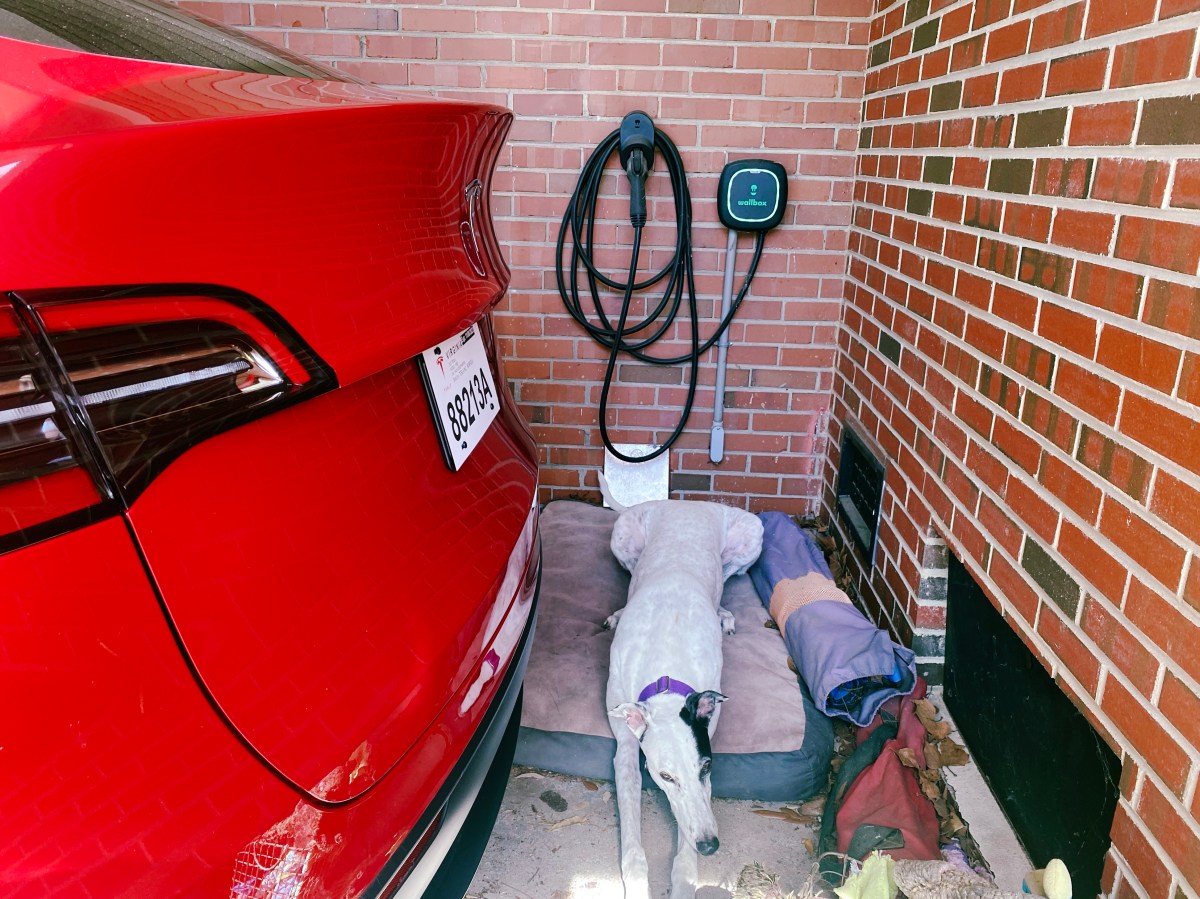
Our WallBox Pulsar+ was originally specified as J1772 to mate up the the ID.4 charge connector. The North-American Tesla Model Y is NACS. Tesla provides a J1772 to NACS “pig-nose” connector that converts J1772 to NACS for destination charging of Model-Y here. In Europe, Tesla uses the 3-phase version of J1772 (different number I’ve forgotten) and CCS. On the continent, most homes have 3 phase power unlike here.
Parking
Tesla uses machine vision and the full self-driving cameras for parking proximity warnings. Multiple stereoscopic cameras identify the nearest obstruction and estimate range to it. Edge detection identifies the curb and adjacent vehicles. This works with some drama, alarms, and re-alarms. Machine vision is still not the equal of a sober Mk 1 eyeball. The backing camera is crystal clear.
Parking head in, the machine vision forward safe distance estimate makes up for the inability to see the Model Y’s nose. I thought I’d miss the sonar distance to the obstruction. The camera is so good, that I don’t need the fixed box or the clearance and bumper lines.
Reversing into the carport, the machine vision seems to be learning the carport. After a week of returns home, it is less shouty than on day 1. The calmest approach is to turn in, pull forward to adjust the line up, then back straight into the carport. I stop with the A-pillar door hinge at the side posts. This keeps the bumper about 2 feet off the head wall.
The drive tuning is much better than that of the ID.4 for negotiating the driveway slope. ID.4 had a tendency to roll if you lifted off on the sloped part of the drive. And rolling off was a bit grabby and jerky. Not so, the Model Y. It will stop and sit feet off. It will roll off smoothly with complete control of creep.
Driving in Traffic
The Model Y does not have a steering column mounted binnacle unlike the Model S and X. The center display has the speed, turn indicators, navigation next turn and distance to the turn. Surprisingly, that makes for a good scan. From the road to the centerline mirror then down to the centerline display to check the Autopilot display and navigation next turn. And finally, the wing mirrors. The left pane also shows the wing cameras when active. The right pane shows the entertainment or the navigation map.
The Model Y has conventional wing mirrors and a conventional rear mirror. The wing mirrors are tapered to reduce drag relative to the ID.4 mirrors. The view aft out the Model Y rear window is better than the ID.4’s tunnel-like view aft. The real magic is in the blind spot monitors. Both use machine vision but the Tesla Model Y lets you see what the cameras see and the system’s evaluation in two ways.
The Autopilot monitoring display is a machine vision rendering of what the cameras see ahead and along side. If a car is in the blind spots, the Autopilot display will show it. If you signal a lane change into a fouled lane, a chime will alert you to look. The Autopilot display also shows the traffic ahead and following distance. The right encoder-rocker lets you move following set point in or out. The right encoder roller lets you adjust autopilot’s speed set point up and down. The right stalk engages and disenages Autopilot as does a tap on the brake.
When you signal a lane change, Autopilot shows the view from the two wing cameras. You can confirm what is over there. When you signal a turn, Autopilot will show you the camera on the side toward the turn.
The Autopilot cameras can almost stand in for mirrors in polite traffic. Unfortunatly, Virginia Beach has rude impatient traffic with fast overtaking and reckless lane changes to exit the road from the passing lanes. The mirrors show the fast overtakers that the machine vision seems to miss.
Minimalism
The Model Y steering wheel mounted controls follow the same minimalism that the interior design does. The limited ornamentation reduces visual clutter that the driver must contend with. Controls are simple, easily learned, and easily remembered. The controls on the steering wheel are simple compared to those on my recent VW-Audi products. I never did learn to use all the doo-dads there for interacting with the phone, audio, and cruise control.
Yet I’ve easily learned the Model Y’s two thumb controllers. I have the left one set up for the radio volume and wipers. The right is set up for the cruise control. No phone buttons. No cruise on-off or lane aid on-off. The drive stalk does all that. The wipers are in auto normally with manual control on the left roller when pushed down.
The left controller is also used to set up the mirrors when stopped. The right adjusts the wheel position and pedal position when stopped.
These are both parked functions enabled from the Vehicle display. One tab is dedicated to driver adjustments and driver profiles. Profiles are paired to the keys and mobile phone BlueTooth MAC addresses. The key presented identifies the operator profile to be loaded. No extra set and recall buttons on the seat trim. The car learns and remembers your preferences for seats, controls, cabin conditioning, etc.





 Dismal Manor Dispatches
You must be logged in to post a comment.