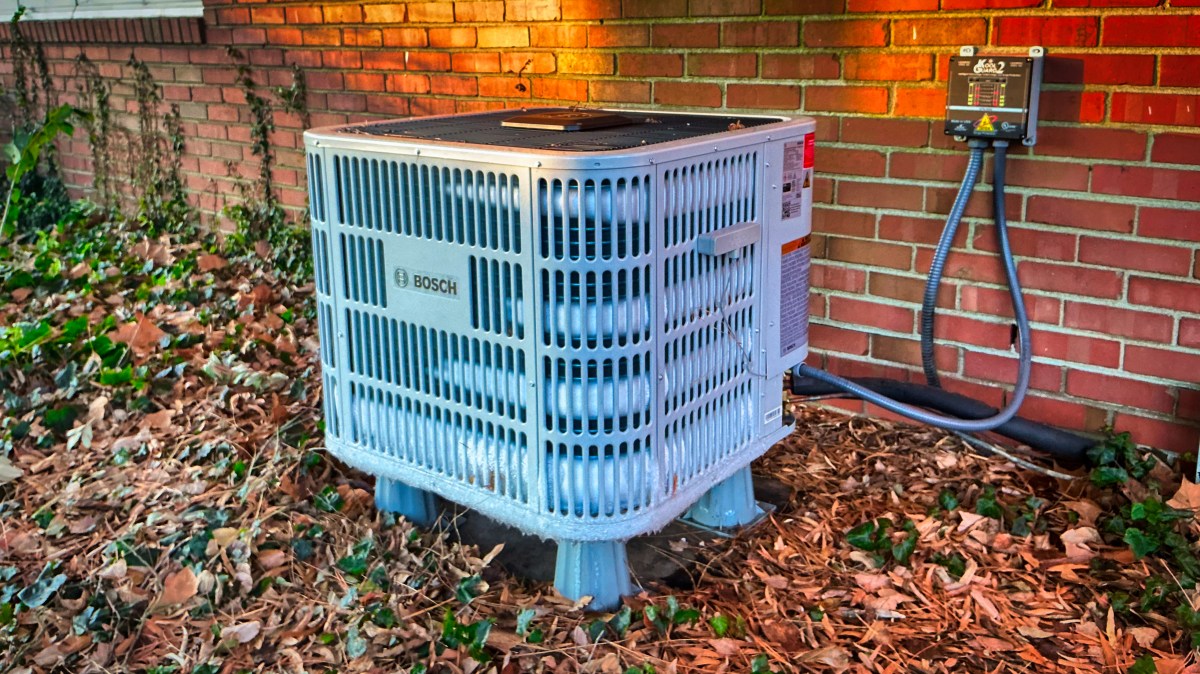
Heating electrification is well underway in the US. For a couple of years, more heat pumps have been sold than gas furnaces. But home owners are just now learning how to go about selecting one for their home. That’s what I hope to explain here. First some background.
With the advent of “cold climate heat pumps”, it is possible to use a heat pump to meet most of a home’s heating needs. Cold cimate heat pumps currently command a premium but the price increase is less than that of adding a gas furnace. In the Southeast and Deep South, a standard heat pump is capable of meeting a home’s heating demand.
Revisions
- 2026-03-20 Original
References
- Consumer Reports Heat Pump Buying Guide
- NEEP Cold Climate Heat Pump Database
- The trade on efficiency metrics
- DOE slick describing cold climate heat pumps
- Northeast Energy Efficiency Alliance Cold Climate Heat Pump Definition and Specification.
What’s a heat Pump?
A heat pump is a system that transfers heat from a lower temperature source to a higher temperature sink. Home heating and cooling heat pumps are vapor compression machnes, a larger version of a refrigerator. How they work is beyond the scope of this article. For our purposes here, it is sufficient to think of them as a whole house sized refrigerator that both cools and heats.
Heat pumps come in sizes
Heat pumps have a capacity determined by the size of the heat exchangers and the power of the motor driving the compressor. The two heat exchangers are referred to as the condenser located in the hot environment and the evaporator located in the cool invironment. A reversing valve allows the two heat exchangers to change roles to heat the home in winter and cool it in summer.
Here in the US, we state heat pump capacity in tons of ice melted per hour. Typical residential machine are in the range of 1 to 5 tons of melt per hour. More recently, and especially for heat pumps, capacity is now stated in BTU/hr. 12,000 BTU/hr is about 1 ton of refrigeration.
The enlightened world uses SI Units (the damn metric system). Heat pump capacity is stated in kilowatts, 1000 joules per second of energy flow. And kilowatt hours, one hour of 1000 watts energy flow. A 5 kilowatt machine moves 5 kilowatt hours of energy per hour from source to sink.
It is possible to convert between the two. For our purposes, 1 ton of refrigeration is 3.5 kilowatt hours of energy. Notice that kilowatt hours are the same units your utility uses to measure the amount of electric power you bought and to calculate your bill. During peak hours, 1 buys 5 KWhr or energy. Off peak, 1 buys about 8 KWHr. Hold that thought, we’ll come back to time of use billing.
Heat pumps have gain
A heat pump has a really neat party trick. One unit of work delivers about 4 units of heat to the machine’s heat sink. We call this energy transfer gain the machine’s coefficent of performance (COP). An efficient heat pump will move about 4 times the electrical input when heating. When cooling, the electrical input is lost to the outside so not counted for the COP.
Heat pump gain varies
A heat pump is moving heat up hill. The steeper the hill, the harder it most work. That is, the amount of heat transfered decreases as the outside temperature decreases.
There is also an operational floor for effective heat transfer. The source temperature must be greater than the boiling temperature of the working fluid in the evaporator for heat to flow to the working fluid.
You can think of the heat pump working as a cyclist riding up a hill. The steeper the hill, the harder the cyclist must work and the slower the cyclist’s speed. The heat pump’s technical specifications include tables of heat transfer rate and energy usage that are parametric in source temperature, sink temperature, and air handler air flow. In a bit, we will examine those.
Local building codes require new heat pump installations to have a cooling SEER2 of 16 or better. A rating of 19 to 20 is good. Some mini-split combinations of indoor and outdoor units quote higher rating that result from use of multiple indoor air handlers and partial loading of the outdoor unit.
In the US, two figures of merit characterize a machine’s heating and cooling performance. SEER2 is the cooling figure of merit. HSPF2 is the heating figure of merit. These figures are an attempt to rate the machine’s efficiency relative to the source and sink temperature difference and the outdoor temperature.
HPSF, heating performance seasonal factor, is a measure of performance for heating. HPSF typical values are in the range of 9-11.
Both figures of merit are designed so that bigger is better.
Defrosting
The heat pump evaporator coils cool below the dew point and will frost up. Or rain and snow may freeze on the coils. The machine periodically runs a defrost cycle. To defrost, the machine pumps the refrigerant around in circles. The heat of pumping the fluid (pump heat) warms the coil, the ice melts, and the machine returns to heating mode. While defrosting, it may energize the aux heat. Our aux heat is about half the capacity of the heat pump so aux heat by itself can’t replace the pumped heat when it is cold.
Heat pumps in the cold
Heat pump performance varies with the outdoor temperature. For heating, the lower the outdoor temperature, the harder it is for the machine to move heat from outdoors to indoors. The machine’s design limits its performance. Heat exchanger size and choice of refrigerants are two factors effecting machine performance.
In the US, there are two ratings for cold climate machines. Both have to do with the machine’s coefficient of performance at a specified outdoor temperature and a standardized indoor temperature. The more common variety have a COP of 2 when the outdoor temperature is 5F. The “cold climate” variety have a COP of 2 when the outdoor temperature is -15F
The COP of both classes of machines declines as the outdoor temperature drops.
Climbing the hill
As the outdoor temperature drops, the hill the heat pump has to climb gets higher. How hard the machine must work gets higher. Eventually, with about a 30F difference between indoor and outdoor temeratures, the machine can no longer make up the losses to ambient and the interior starts to follow the outside temperature downward. Eventually, the auxiliary heat will come on. These are resistance heaters (PTC heaters like a space heater on steroids). My system has one 5KW bank installed, or about 1.5 tons of aux heat.
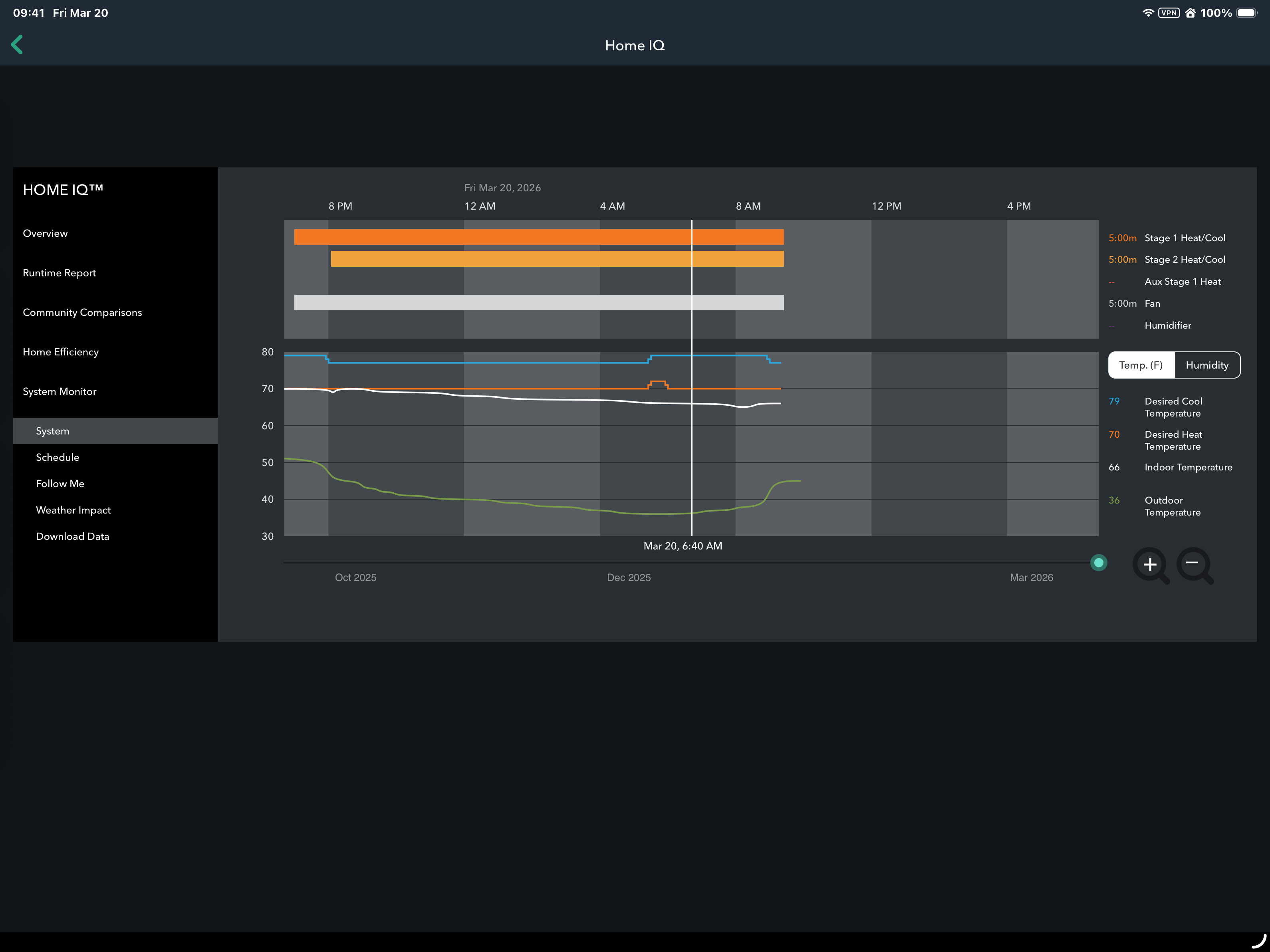
Dismal Manor IDS
Sizing a heat pump
There are a number of ways to size a heat pump. In the US, contractors are supposed to do a Manual J calculation. This is a tedious exercise in data collection to determine the size of each space, how the building envelop is constructed, how much insulation is present, and how much of the wall is windows and their thermal performance. Lots of tedium and computer modeling later, a number comes out.
Design Temperature
A bulding’s heating and cooling is designed to a heating design temperature and a cooling design temperature. The heating design temperature is a first percentile temperature, 99 percent of hours are warmer. For us, 22F is the magic number. NOAA determines this data from the climate record. For Dismal Manor, the Norfolk Airport (ORF) is the reference location. There is a degree or two of variation among Norfolk Airport, Norfolk Naval Air Station just to our west, and Oceana Naval Air Station about 15 miles southeast.
Just recently, iPad Pro and iPhone Pro applications use the gadget’s camera and lidar sensor to deterine the size of each room and the widow sizing and placement. This greatly reduces the time for the site survey. But I have yet to see an engineer use it.
All methods are rubbish
They work sort of. But the sizing is at best a rough measure of the building’s gains. The truth is that the method is fiddly and ignores air infiltration. Air leakage, be it through gaps in the construction or foot traffic, is not considered. And the actual type and amount of insulation may not be to specification or to code. The insulation must be installed with care to achieve its rated performance.
But if you know your current system’s performance and break even temperature, you have a good reference point for estimating the structure’s gross heat load and heat transfer coefficient. Given that number, you can estimate the heat load at higher differentials for the structure as it is.
Designing for cold
Northeast Energy Efficiency Alliance gives the following guidelines for heat pump selection.
A cold climate DHP (ccDHP) refers to those that meet the following minimum specifications:
- Compressor must be variable capacity (inverter type)
- Indoor and outdoor units must be part of an AHRI matched system
- AHRI matched system must be rated ≥ 10.0 HSPF
- AHRI matched system must have ≥1.75 COP at 5°F
- Deliver ≥80% of rated3 capacity at 5°F
- If a drain pan heater is present, it may only run as part of the defrost cycle
As the outdoor temperature drops, the amount of heat it can move decreases. The result is that there is no single number on a spec sheet that you can look at to pick a heat pump.
Manufactures provide tables of performance determined by testing the machine while both sides are placed in environmental chamber s to control the source and sink temperatures. These are varied, the heat transferred is measured, and the energy used is measured. These values are tabulated for standard indoor temperature, outdoor temperature, and inside air flow. Yes, it is complicated, a 4-dimension scalar field.
But you’ve got to look. At local design basis temperature, the heat moved must exceed the heat lost by the building to ambient. When it doesn’t, this happens.
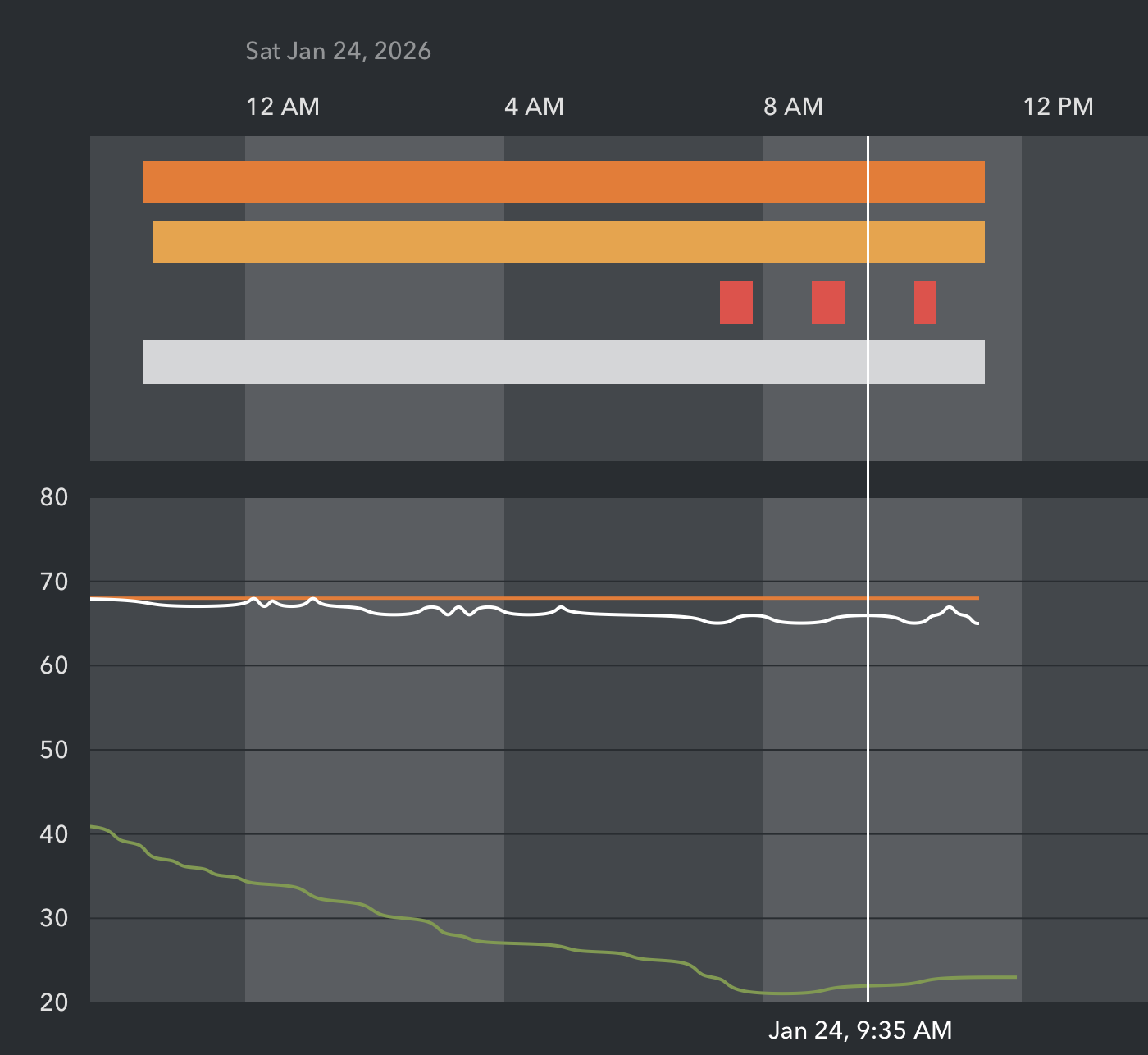
The heat pump is not keeping up
Aux heat begins to cycle
Ecobee thermostats provide two big advantages
- They participate in Dominion Power’s demand management scheme.
- They track the building temperature, outdoor temperature, and set points. The graph shows how the building responds to its enviornment and to the HVAC plant.
On this cold night, the building temperature tracks the outdoor temperature downward. My new machine can maintain about a 32F difference between indoors and outdoors. When it is 32F out, the machine holds about 65F indoors. If it gets colder, the $5/hour aux heat comes on. The colder outside, the more time the aux heat is on. During the cold snap, it was down to 17 F. The aux heat was on continuously that night. February’s usage was 2500 KWh or about $500 because of high aux heat on-time. Normal winter month bills are below 1000 KWh. That’s looking at 2026. In 2025, the gas furnace carried the cold month night load.
The vendors wing it
One thousand square feet single story wood frame mid-fifties modern, Local building codes require new heat pump installations to have a cooling SEER2 of 16 or better. A rating of 19 to 20 is good. Some mini-split combinations of indoor and outdoor units quote higher rating that result from use of multiple indoor air handlers and partial loading of the outdoor unit.
HPSF, heating performance seasonal factor, is a measure of performance for heating. HPSF typical values are in the range of 9-11.that three tons innit? Expect one rated better than 10. Once the walls have been sheathed, it becomes difficult to evaluate the adequacy of the insulation. And nobody does.So they just oversized the furnace and transitioned to it when the heat pump couldn’t keep up.
That worked when there was a gas furnace for back up. With electric aux heat in my building we just barely make it. Follow the handbook. Let the computer code make its assumptions. And hope for the best. According to building science folk, Manual J designs are no better than sailor’s eye designs. But in the past, heating engineers relied on that over-sized gas furnace to save their bacon.
Progressive heating engineers are turning to machine vision, LIDAR measurements, and sophisticated machine learning models to estimate building tightness, wall conductivity, and make-up heat needs. The Heat Geek franchise in the UK is in the forefront of this technique but the tools are crossing the pond.
Given the building data, one of the things the supplier should do is to check the proposed equipment’s performance tables to determine the amount of heat that it can provide at the design temperature, design air flow, and client’s preferred indoor temperature, usually 68 F to 72 F.
The vendor may choose to include some aux heating to make up for any shortfall and to improve temperature control near the design temperature. The outdoor temperature is usually outside the design temperature range fess than 70 hours per year. Sweaters and hoodies time. In a typical year, this choice is cost effective. The strip heaters are cheap and the air handler includes them.
When it is cold
Two characteristics of the building determine the amount of heat or cooling needed. The first is the conductivity of the building envelope. The second is the tightness of the building envelope.
Conductivity
Heat conduction through the building envelope is linear in the temperature difference between inside and outside. As the temperature drops, the difference will reach a point where the inside temperature begins to creep downward. With a little work, you can determine the heat that the heat pump is supplying. Knowing the delta-T, you can calulate the conduction equation’s gross thermal conductivity factor for your building. Having the gross conductivity, you can estimate the energy transfer at other differential temperatures.
Tightness
The other property of the structure effecting heat gain and loss is the tightness of the structure. When it is windy, the wind flowing into and around the structure will develop a differential pressure field that drives air exchange between the building interior and exterior.
In a mid-fifties modern structure like mine, leakage occurs at penetrations through the building envelope — at doors and windows but also at roof deck penetrations, ceiling penetrations, the attic entrance, etc. Venting the roof deck is important to maintain conditions that block mold growth on the sheathing and roof framing.
The machine is struggling
Have it serviced. Clean the heat exchangers and replace the filter. A dust-laden filter will reduce air flow compromising performance. Airflow through the air handler is one of the parameters in the performance table. A 20% reduction in air flow can be trouble. Clean is good. Regular cleaning is good. And inexpensive.
Plan A
Insulate. Insulate first!
We have done a good bit to the building envelope including modern windows and doors that reduce air infiltration. But checking the attic, it is poorly insulated. The builder poured in vermiculite. The beloved first owner added some fiberglass batting. The whole is pretty chaotic and not to code. So next steps are to insulate the attic to code, R49 in Norfolk (and all of Virginia).
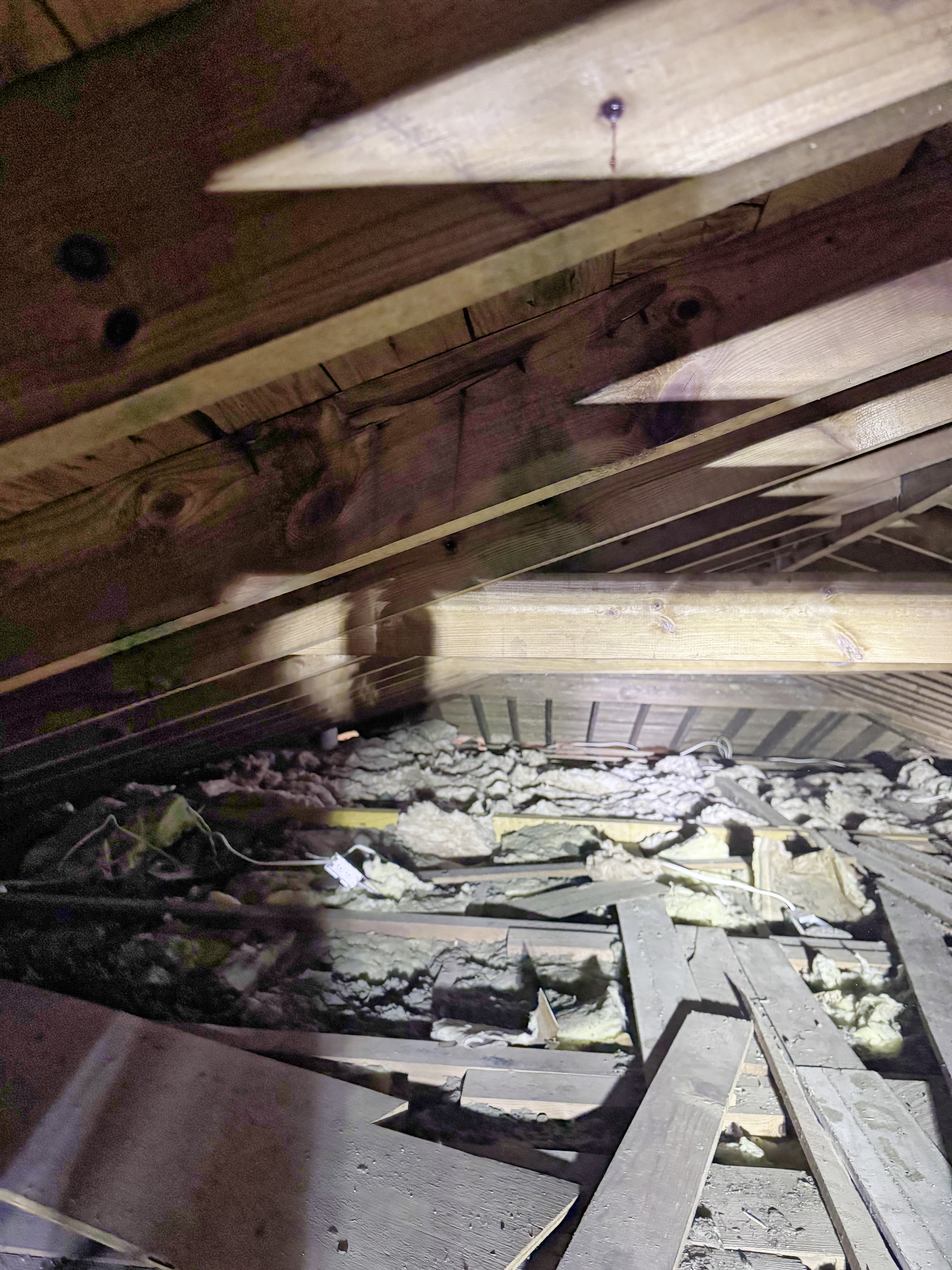
The contractors had removed the legacy R19 batting
Adding attic insulation to R49 costs about $4/ft-sq but is well worth the money spent. The contractor will inspect and air seal ceiling penetrations like can lamps, plumbing penetrations, heating penetrations (registers and returns), etc to minimize moisture penetration into the attic. They will then blow in fiberglass insulation material to a standard of R49, the code value for new installations in Virginia. This process is surprisingly quick if the installer is well organized. Updating of 1000 square feet took about 2 hours.
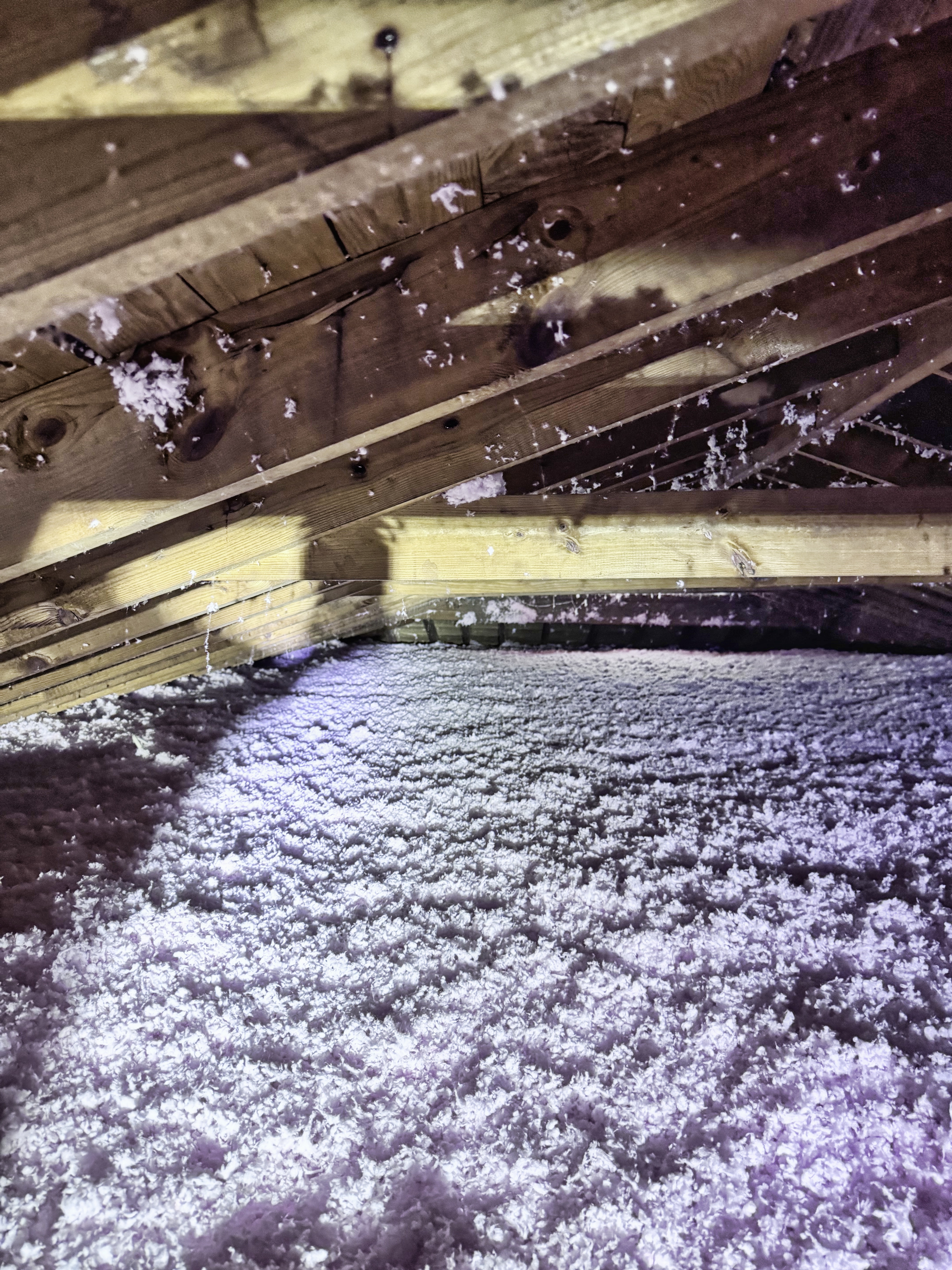
R49 Owens Corning blow-in loose fill
With proper insulation, the ceiling stays warmer which reduces the drafts of larger spaces. This was particularly noticable in the lounge.
Plan B
Reduce air infiltration. If needed, replace leaky windows and doors. Replace the attic hatch. Have a foam bonnet made to seal the penetration by capping the stair opening. This should stop the air exchange between the attic and the living areas.
The attic pull down door and vented attic conspire to increase heating needs. I don’t dare close off the gable vents as I don’t have summer mosture trouble. But I can better close the attic access hatch by adding a foam board bonnet that fits snugly in the hatch frame. This is a box knife and duct tape (the metal foil kind, not gaffer tape) project within the ability of a fit homeowner.
Using 25 mm ridgid closed cell foam board, fabricate a box deep enough to come above the stair when setting attop the door frame. Add a top plate sized to the exterior width and length of the box. Tape the whole thing up. Pull the bonnet down into the the opening. THen close up the hatch.
Plan C
Add heating. But keep in mind that you can speend several thousand dollars for equipment that is needed only 100 hours/year. That’s what the design basis temperature represents. The other 99% of hours are warmer than design basis. A 5 KW aux heat source costs $1/hour or $100 to $200 per year to operate. Similar additional capacity from a mini-split would cost more for hardware than you would likely recover during the machine’s 20 year service life.
But if your primary heat his struggling above freezing, it is reasonable to add capacity. Here, I would add a cold climate rated mini-split to provide additional heat in the open plan lounge. This open space is about half the building’s floor area. Being open, it is well suited to addition of a wall-mounted air handler. To be effective, this machine must be cold climate rated to maintain performance at 22 F, our design basis temperature. Capacity at 22F should be confirmed by review of performance tables.

 Dismal Manor Dispatches
You must be logged in to post a comment.