
This summer, I bought yet more Schiit. I added a new phono preamp and turntable and a new DAC to the Dismal Hi-Fi. No, my stereo is not 4-way. Just 2-way. But it is fully meshed and forked now. Both new devices are ForkBeard equipped. As usual Schiit and ForkBeard double entendres are required. Sorry.
In this post, I talk about the changes to the rig here at Dismal Manor. As I was writing this post, Schiit released Byggy, its delta-sigma version of Yggdrasil. This is the first DAC by any audio manufacturer that uses no purchased conversion technology or reconstruction technology. Schiit built Byggy straight out of scratch. [6] Schiit calls its new delta-sigma modulator plus custom reconstruction filter “Mesh architecture”. Singular is Schiit’s home-brew delta-sigma modulator design.
Revisions
- 2025-10-24, original
References
- Dan Clark Aeon RT product page
- Schiit Magni-Unity product page
- Schiit Skoll product page
- Schiit Mimir protuct page
- MapleShade Furniture
- Schiit Singular, A long time coming …
- The End of the DAC as we Know It, Schiit Mimir Mesh Architecture
Lounge Make-over
This August, I replaced our Ekornes Stressless love seat with an Ikea Mobaro couch and chaise combo and had electricians replace outlets and hang the TV for me. I moved the audio kit from the old ’80s presentation furniture to new places atop and inside an Ikea Stockholm side board shown here. There’s still a rats nest of cables behind the side board courtesy of all the network bits supporting streaming TV and audio. But that kit is safely hidden inside the side board along with power distribution. The power conditioners were too deep for the side board.
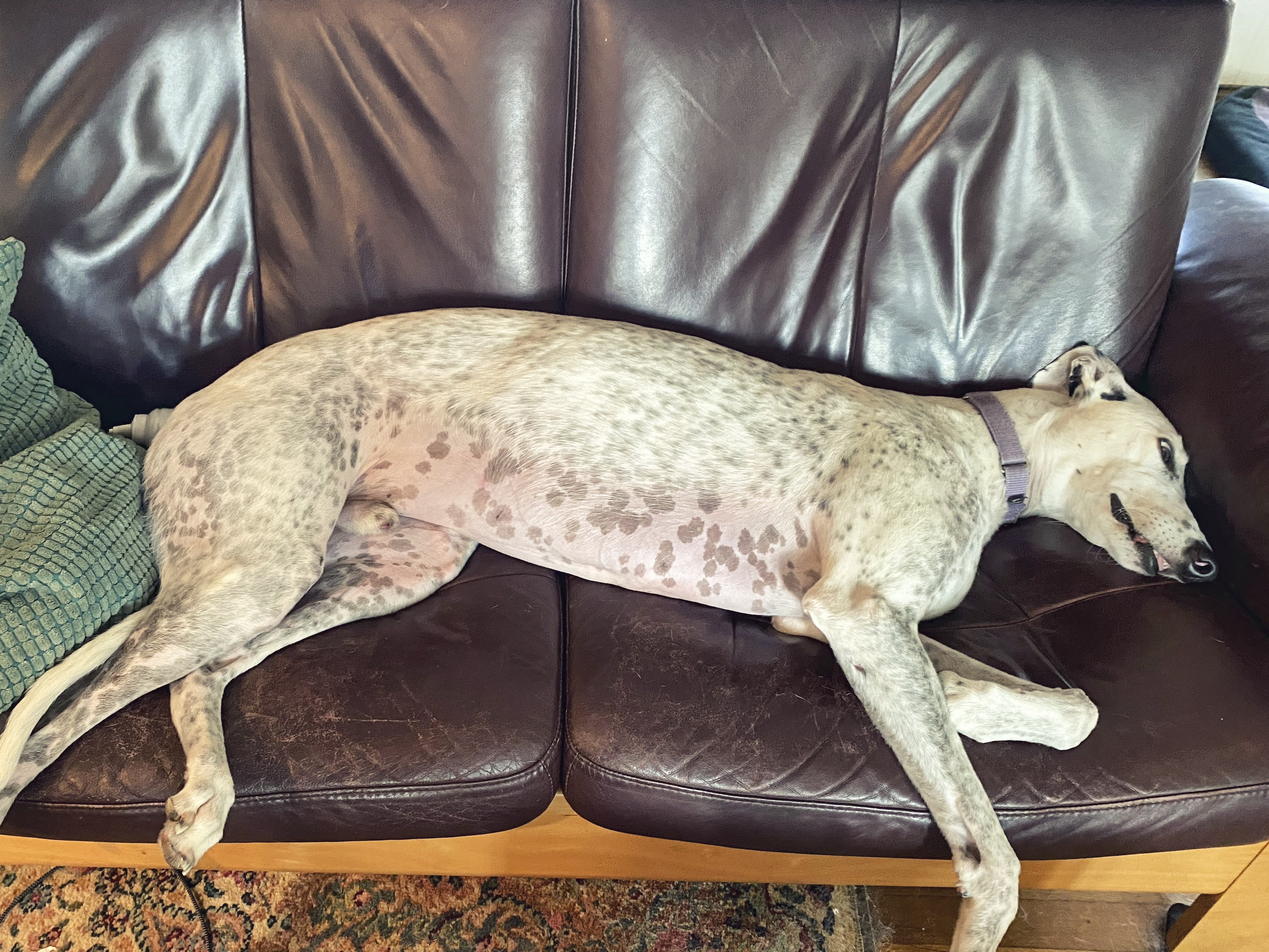
LP’s out of storage at last
I ordered some record racks from the Maple Shade Store. These are Maryland maple precisely machined and finished with catalyzed flat varnish. They come flat packed but are easily assembled with wood screws and a Yankee screwdriver (ratcheting). Each holds about 150 disks. I had managed to accumulate 300 or so over the years.
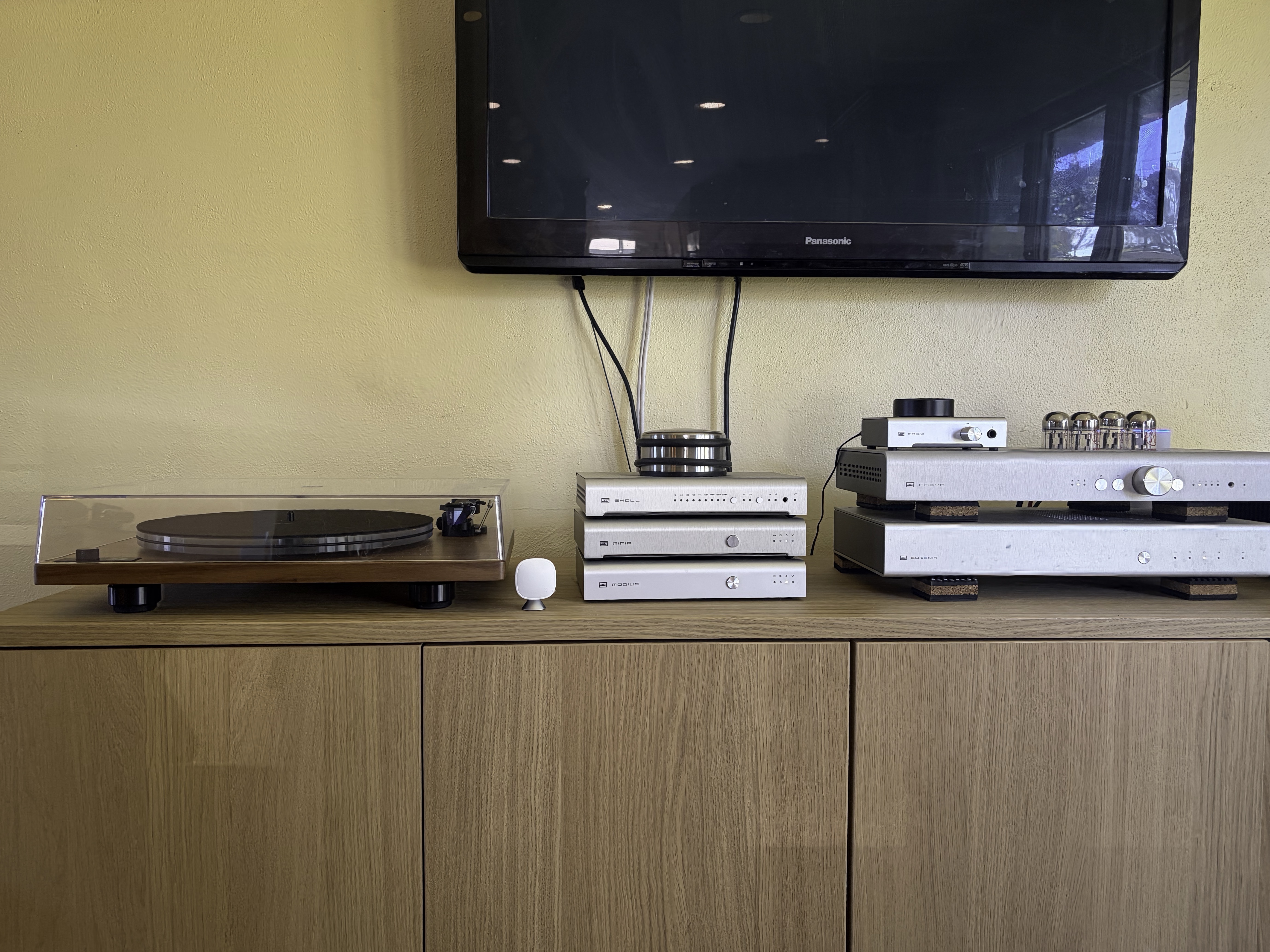
While I was at it, I purchased a new U-Turn Orbit Theory turntable and began to play LP again. The Orbit Theory comes with an Ortofon M-2000 Blue cartridge. LPs now sound glorious again. Maybe for the first time ever as the Skoll-F preamp is dead silent, RIAA is spot on, and it is flatter than Kansas.
The Ortofon Blue is the best sounding phono cartridge that I have heard. It performs excellently on vocal, jazz, and orchestral music. Tracking is good, voices natural, drums and cymbals have transient clarity. Cymbals sound live, well to 77 year old ears. No 18-ish crawly skin.
Aeon RT and Magni-Unity
This summer, Jason Stoddard and Dan Clark teamed up to offer a set of Aeon RT headphones plus Magni Unity DAC plus headphone amplifier at a nice summer discount. They’ve had this summer doldrums sale for the past few summers, mostly to attract new listeners to the two brands and to value audio equipment.
I bought a set to use in my study and found I really liked it. The new Magni is an ESS 9028 based DAC with a new audio topology. It sounds quite nice but not as refined as the multi-bit R2R DACs in the Schiit line. The Magni Unity line stage is now discrete. The Aeon RT joins HiFi Man Sundara cans. To my ears, Aeon RT has a more natural treatment of double bass and bass guitar than does the Sundara. Both are good in the midrange. Being closed back, the Aeon RT is quieter and better at portraying small sounds.
Both headphones have a flatter image than the Maggies but place things nicely. in pan.
Mimir
I had been curious about Schiit’s combo burrito filter plus ESS DAC mashup since Jason began teasing it earlier in the year. Mike, Dave, and Jason hit this one out of the park. The sound is neutral. The transient response (cymbals, drums, piano, vibes) sound approaches that of Gumby multi-bit. It’s not quite as detailed but is well focused in pan and depth. It can be pin-point spooky focused on video Folley artist effects in movies. And, they can offer this puppy for $300. More for silver. More to get Forked.
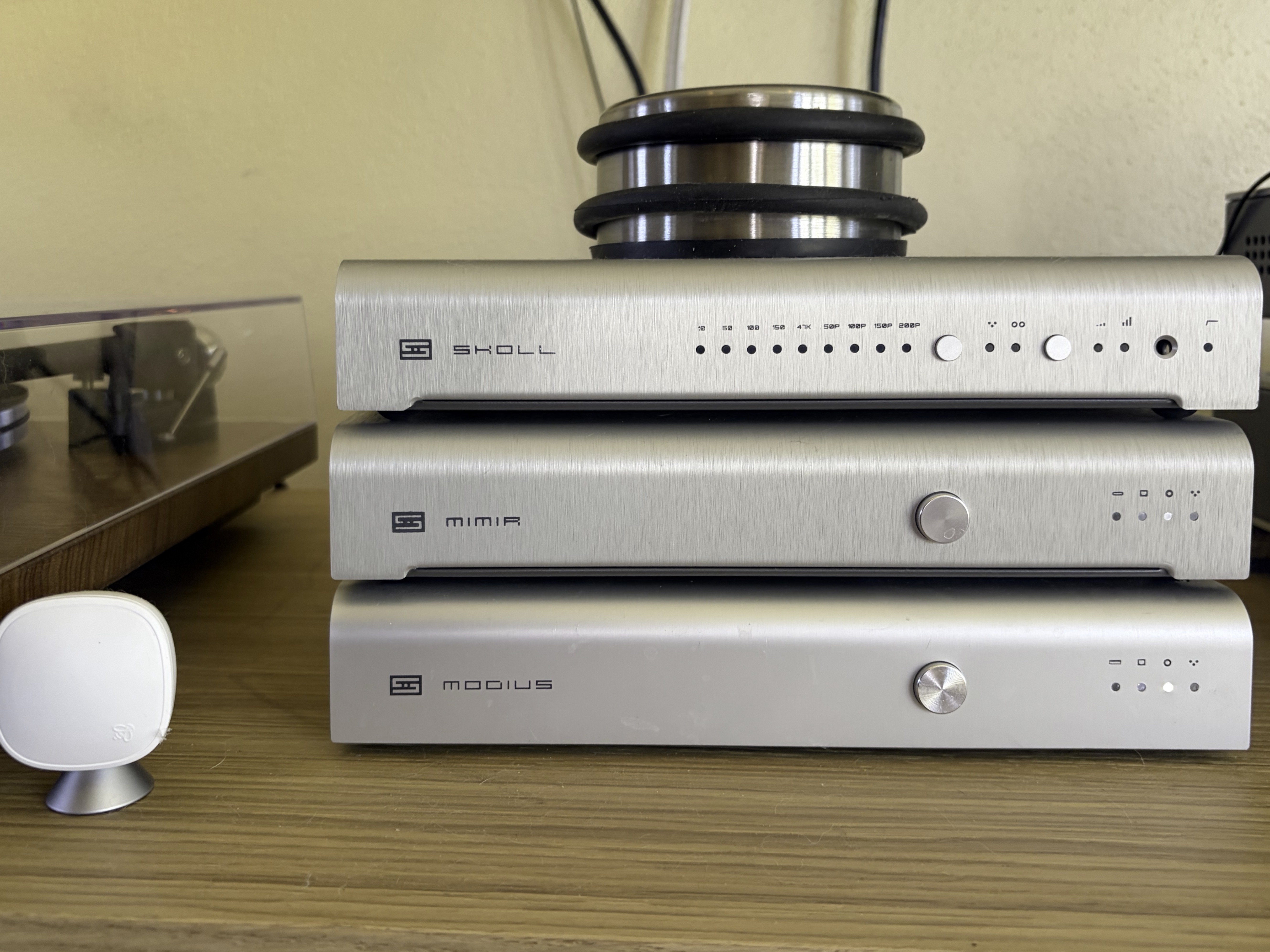
Forkbeard
Forkbeard is Bluetooth’s bastard son in Scandinavian folk tales. And ForkBeard is a remote control protocol easily baked into Schiit audio having a PIC-32 with DSP instructions to run the panel and do internal and supervisory stuff like turn-on soft-starts, ladder attenuator operation, bias management, output protection, Unison USB-C Audio 2 processing, etc.
I ordered Forkbeard for Skoll-F and later for Mimir. I use Mimir with the USB-C input connected to a Pi-4 RoPieee streamer. No bonnet on this one. Just Raspberry Pi and RoPieee. The TV connects to the optical. The Sangean DT-20 FM-HD tuner connects to the coax. The AES-3 input is idle.
Schiit includes the ForkBeard code with the Unison USB-C Audio 2 processing. Any recent product having Unison USB is a candidate for ForkBeard. The BlueTooth modules are interchangeable from product to product. ForkBeard has proved of limited use with Skoll-F but is used daily with Mimir to switch inputs. In my experience, it is most useful for input selection and for equalization and loudness control.
With ForkBeard, Mimir has become my favorite DAC for Rhodes and vibes small ensemble jazz and pop like Ray Manzarek playing Rhodes on Riders on the Storm. And all TV and video. I switch to Gumby for large ensembles and for its more focused drum sound.
Mimir also has a “loudness” feature that changes voicing from flat to Harmon curve. Schiit builds this curve into all ForkBeard implementations. At the left side is a slider that lets you adjust the strength of the loudness compensation.
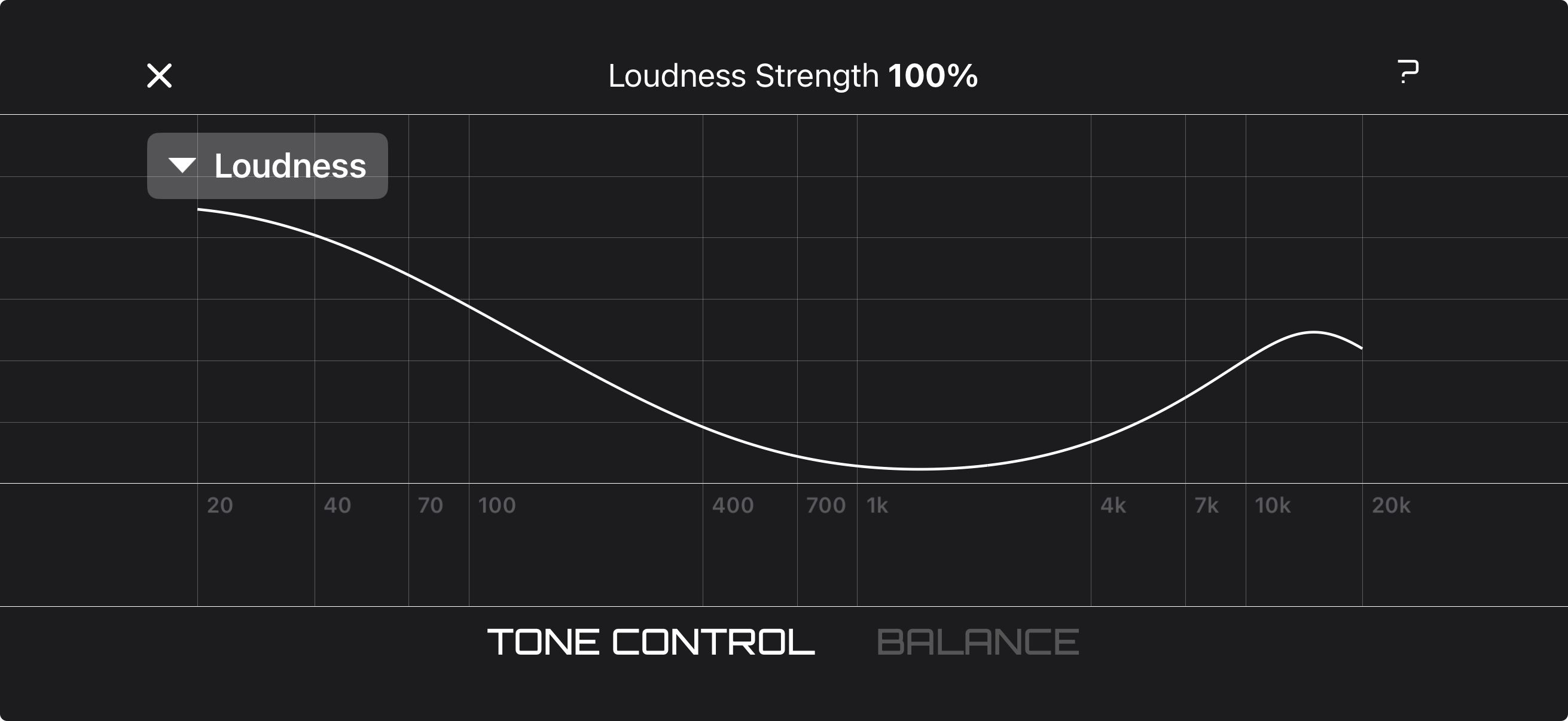
ForkBeard APP Screen Capture by the author
Schiit’s loudness implementation boosts the bass some but not in the tubby way my Dynaco PAS-3 did. The mid-range is flat. The treble rises from 1K.
Some months ago, I fiddled around with the AirPods Pro 2 accessibility features. One of the things it can do is give you a hearing test, determine your deficits, and make a compensation curve for your ears. I discovered I had a good bit of HF loss from 2.4 KHz or so up. Applying my custom compensation curve, Air Pods Pro suddenly had bass and cymbals!
Schiit’s loudness curve is a common one designed around median hearing loss. It restores some treble and boosts bass in a natural but seamless way.
Good but cheap promotes collecting
This new or not so new generation (Aeon RT is 5+ years old) of good-sounding but value-priced kit encourages collecting. If you watch the headphone reviewers, their set backgrounds are stacks of head amps, DACs, and headphone trees holding review references and favorites that they’ve accumulated over the years. They tend to line up a specific head phone rig for favored recordings.
Singular is Shipping
True artists ship. This weekend, Schiit announced the availability of their Singular DAC by e-mail. Jason has added the story of its development to Schiit Happened at Head-Fi
Mike, Dave, Jason, Martin, Ivanna, and team have completed development of Schiit’s Singular DAC. Mike, Dave, and Ivanna (their tame PhD mathematician) built her straight out of scratch. Martin introduced process with formalized product concept, product functional requirements, and documented architecture and math. Could Schiit be an ISO 9000 company someday? Scary!
The team designed a delta-sigma modulator and implemented it in an FPGA. They developed a new Mesh combo burrito reconstruction filter for it. And Jason fit the whole schemer along with Unison USB-C Audio 2 on a Yggdrasil input card. It is now one of two input options for Yiggi. The second is the Less-Is-More multi-bit D to A.
This is a pretty significant accmoplishment spanning 6 or so years of development. Jason tells that part of the story in his “End of Multibit” post at Head-Fi.
As is Schiit custom, they don’t comment on how things sound. With their equipment, most of the product to product variations are in the imaging and sound staging. Are instruments presented as points in space or beach balls in space? Are they placed in depth? Product to product transient response also varies. And are percussive instruments sharply focused or a bit smeared? Their combo burrito filter brings things into sharp focus spatially and temporally. It gets better with each iteration as code gets closer to the math.
Mimir is Singular for the rest of us
Byggy and Mimir are cousins.Byggy is Singlar straight out of scratch. Mimir is Singular implemented using mass market components. Where the Biggy delta-sigma modulator is home brew, coded in a Xilinx FPGA, Mimir uses the one in an ESS 9028 DAC. Register settings let you disable the ESS digital reconstruction filter. Schiit substituted one of its own using a simplified version of the Mesh combo burrito filter. Final reconstruction happens in the analog stage. ESS lets you do that on your own also. Mimir uses op amps for both single-ended and balanced outputs.
By contrast, Byggy has a scratch-built delta-sigma modulator, the full Mesh reconstruction filter in a DSP, and a complex discrete output stage, oh and a choke input power supply. And costs 8x Mimir. $2500 vs $300. For a bit more focus and a bit more transient realism if you have speakers like the Maggie LRS that can render focus and transient detail.

 Dismal Manor Dispatches
You must be logged in to post a comment.