Tesla Motors had made April 2024 its Full Self-Driving (Supervised) product debut. The debutant has been in gestation for about 16 year and has just come of age. FSD (supervised) is amazingly competent most of the time in coping with meeting sections and right of way at intersections. And it can be tuned to be chill, standard, or assertive at intersections. These determine the amount of margin to require during intersection maneuvers. All in all, an amazing achievement that was cutting edge research 10 years ago (and may still be).
I’m not an expert and not a fan. And I’m a poor retired moocher. What is it like? What do I think of it? Read on.
Revision History
- 2024-04-10 Original
- 2024-04.11 Add an applicability statement, car history, and clarify that I’m talking about Release 12.3.3 as Tesla is still making running changes to FSD.
- 2024-04-15 Add a link to the Dave Anderson interview on Dr. Know-It-All’s YouTube channel.
References
- A Unique Perspective on Tesla FSD 12.3.3 , An autonomous vehicle engineer summarizes self-driving vehicle history, places Tesla Full Self-Driving (Supervised) in context, and demonstrates the product during a drive in rural Florida. The video speaker has 30 years experience as an autonomous vehicle engineer. He has worked on on-road and off-road vehicles including several that participated in the DARPA autonomous vehicle grand challenge series. He shows clips of several of the projects he worked, sensors and computing used, and results. This individual was one of the original authors of the Joint Architecture for Unmanned Systems. He concludes the video with a description of FSD (supervised) and a narrated drive on Florida country roads.
- Tesla Full Self-Driving (Supervised) release 12.3.3 is described here. Tesla moves fast. This release had been out about 2 weeks when 12.3.4 was released. It is not here yet. I hope they have retuned the fast starts and stops.
- Autonomy EXPERT Reviews Tesla FSD! 👍👎?! Doctor Know It All interviews Dave Anderson, the researcher who prepared [1]. John interviews Dave about his experiences building the three DARPA Grand Challenge vehicles that he built as research team lead.
My Car History
In about 1965 I learned to drive. At the time the family cars were a 1956 Pontiac Star Chief which was Dad’s daily commuter and a 1962 Dodge Polara that Mom drove. Both had “road hugging weight and a not so big V8.
In 1968 or so, Dad traded the aging Star Chief for a 1968 California 3-speed drop top Mustang with California emissions control, a dramatic live rear axel, and more motor than brakes. When Dad passed away, I inherited the car and took it to RPI for my graduate year and drove it during my Navy years.
In 1976, I bought my first new car, a Datsun 280Z with analog electronic fuel injection. That was a fun car modeled after the Jaguar E-type.
After 10 years, I retired the Z-Car replacing it with a Mustang SVO. A turbocharged 2.3 liter Pinto motor and another live rear axel on big Goodyear Gator Backs, it was a fright in the snow but had some pep.
In ’92, a Taurus SHO replaced the Muskrat. I kept the SHO for 10 years until it started having gremlins in the starting logic and would not fire when hot. Once cooled down, it would start and run until shut down. It did not like being hot (normal operating temperature). Mr. Ford didn’t try very hard to run that one to earth.
In 2002, and Audi A4 Avant replaced the SHO. Family car with a stick. And a great dog car. It reminded me of the joys of having a hatch. I kept the A4 until a traffic light mishap killed it. A befuddled driver got the wrong pedal.
A MK 7 GTI replaced the A4. My first automatic. The first automatic I was willing to pay for. Great little car but a tight fit for a big dog and an older me. And I couldn’t get one with navigation and ADAS. I had to settle for the mid-trim.
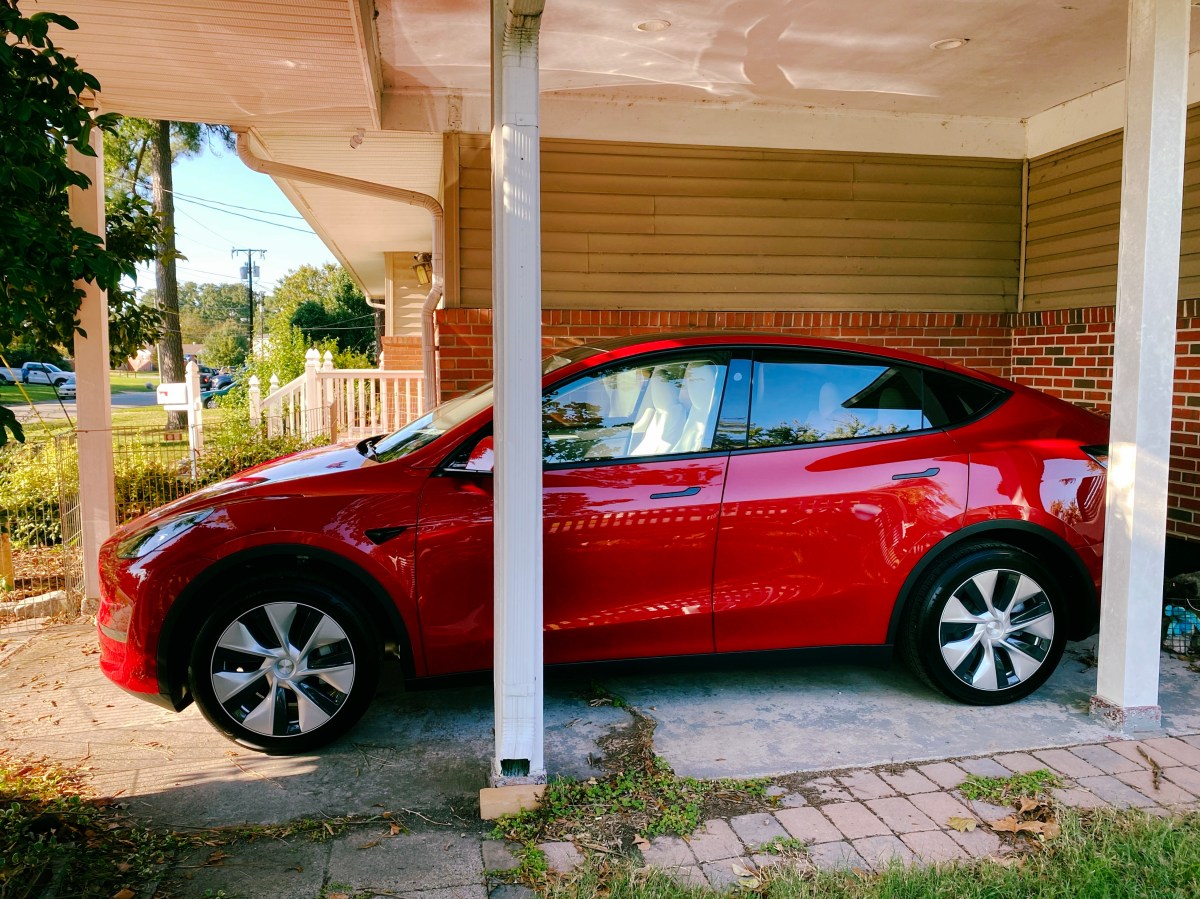
In 2021 I traded the GTI for an ID.4 AWD Pro S Gradient. I still have the ID.4 as VW is still trying to mend it following April 2023’s mishap. While waiting for the car, a conquest purchase of 2023 Tesla Model Y Dilithium Dream happened. The “replacement rental” was costing a car payment so why not make a car payment? The Model Y has slowly won me over. I bought new to get several early year changes Tesla made as running changes. The car is just full of Easter egg delights and a joy to drive.
Full Self-Driving (Supervised)?
Tesla Full Self-Driving (Supervised) is perhaps the most comprehensive attempt yet at developing a vehicle that is able to drive itself on a public road motor trip. The presenter in the video estimates that FSD (Supervised) is capable of handling 97% to 99% of all roadways and encounters in US driving.
FSD (supervised) is the part of Tesla AutoPilot that follows routes and negotiates road junctions, turns, and traffic controls. Regular AutoPilot provides traffic-aware speed control and lane following but cannot respond to traffic controls or negotiate intersections. A driver must do these tasks when standard AutoPilot is in use.
How FSD (supervised) appears to work
FSD (Supervised) uses sensor perception of roadways and the vehicles on them to control a vehicle traveling on the roadway. Tesla’s current vehicles have 8 exterior cameras, 2 on driver side, 2 on passenger side, 2 front looking, 1 aft looking, and 1 passenger monitor.
Tesla Vision processes these cameras to identify the significant features in the visual system’s field of view. It separates the objects in the imagery into background fixed objects and movable objects (vehicles and animals) of interest that it incorporates into its working field of regard. It determines relative motion to identify collision hazards.
A forward stereoscopic camera is processed to determine range and closure rate of objects in the forward field of regard. It processes bearing rate to identify crossing vehicles presenting a collision risk.
It steers the vehicle to follow the roadway. It senses and responds to traffic controls including signals and signage. It also senses and complies with lane use control markings (travel, left turn, and right turn markings). It stops at stop signs and stop signals staying behind the stop line. It checks for a clear intersection free of collision risks before proceeding.
In following a route, it takes turns as needed. It makes lane changes as needed to comply with lane use when it is clearly indicated.
And FSD (supervised) does all of the above remarkably well. It generally needs the operator to take the vehicle out of its parking stall and to drive it the last few hundred feet of a trip to a new parking spot. Once there, the vehicle can park itself.
(Supervised) ?
Tesla FSD (supervised) still requires a human coach to deal with novel situations encountered in our messy world. Some things FSD (supervised) needs help with include the following.
- Backing, it can’t back up, not even for simple things like to correct an intersection incursion on a stop that went long.
- FSD (supervised) can’t do detours. Correctly interpreting detour signs generally requires either local knowledge or faith. FSD (supervised) gets by with perceived context so it has little of either.
- Rain and snow. Visibility limitations will trip it up. But also the presence of lubricants on road surfaces. Wet and snowy roads greatly increase stopping distance. Downhill stops on wet or icy roads are especially hazardous. There are no datasets modeling these conditions so human experience and caution must take over.
- Don’t event think about “black ice”.
- Obscured lane use markings (like those occluded by heavy traffic) cause trouble. The car can’t acquire the lane use info needed to correctly negotiate an intersection. Navigator usually has them in its road segment database but it is unknown whether FSD (supervised) receives them.
- Shifted lanes at an intersection give it trouble. Norfolk has many intersections where a one lane shift occurs in the intersection. Kempsville Road at Virginia Beach Boulevard is a classic example.
The Moocher’s Impressions
FSD (supervised) has a lead foot but it can park! To me, the current tuning his hotter than I’d like. I’ll explain how the hot tuning presents and how it affects supervising FSD.
Stopping in the roadway
FSD (supervised) uses higher acceleration and deceleration rates than most drivers prefer. The general public thinks 1/4 G acceleration is a bit much. The current tuning results in hot launches and abrupt stops approaching traffic already stopped at a traffic control.
This is FSD (supervised) normal behavior. The problem is that abrupt stops leave little margin for the operator to stop the vehicle should the vehicle have failed to perceive the need to stop. Most operators prefer a more gradual coasting approach to stopped traffic to give the close follower an opportunity to orient to the stop and stop without collision.
The abrupt tuning makes minding FSD (supervised) more fatiguing than driving one’s self.
Speed control
When in a line of traffic, FSD (supervised) does an excellent job maintaining a proper interval and slowing to a stop gently with traffic. And it does this without radar ranges and range rates. Following happens using just stereoscopic vision analysis of the view ahead. Tesla has this capability about right.
Negotiating Curves
FSD (supervised) appears to require some track error to build before beginning to guide around a curve. On a sharply curved road, entry to the turn is abrupt. Is it going to turn or is it going to hit the curb or oncoming traffic? It appears to err to the outside on a divided roadway but it also feels abrupt when only paint separates you from the oncoming traffic. The later the turn in, the less time for the operator to react to avoid a mishap.
Voyage Planning
The navigator’s voyage planning is a problem. The route planner appears hell-bent to minimize either a time of travel or a distance of travel cost function. There appears to be no complexity metric in the cost function to limit unprotected left turns for example.
A good example is the drive from Wegmans to Fresh Market to complete my weekly shop. The navigator’s route around Wegmans anti-clockwise involves left turns in the middle of a busy block that is a shortcut for through traffic. It is much easier to drive clockwise around Wegmans.
And navigator always pitches the first driveway entrance because it lacks knowledge of most car parks and the preferred ways through them. Finding a SuperCharger is always an adventure because navigator can’t get you from the road to the stalls across the lot.
When Would I Engage FSD?
Around Norfolk and Virginia Beach, we have too many kinky roadways, a very high mishap rate resulting from creative and selfish driving, poorly designed roadways (multi-lane fast arterial streets). And many cases of misaligned lanes at intersections.
I’d probably only use the parking feature around town. It works well parallel parking and reversing into the other kind of parking. Tesla has nailed parking maneuvers. But it won’t head into an angled space like those in our church lot. Head in parking is a task left to the operator.
I’d use FSD on the highway portion of road trips. But this is the province of standard AutoPilot. Motorway travel is still rules based rather than neural net visual perception classification based.

 Dismal Manor Dispatches