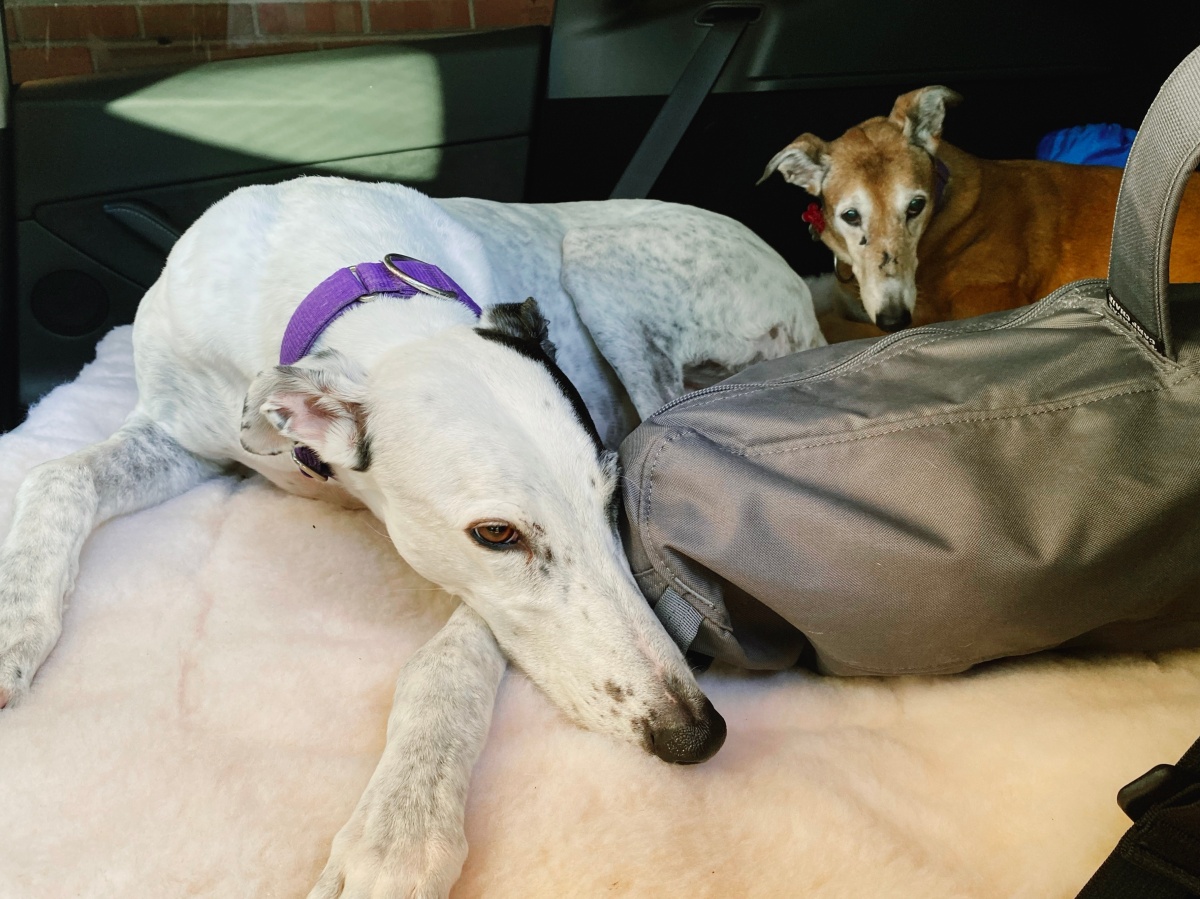
James River Greyhounds has an yearly picnic for the adopters. Every year, hounds from all over Virginia gather at the “farm” for fun and games and several fundraising events. It’s a bit of a report to the members and adopters of the year’s accomplishments and the state of the group’s finances followed by a fund-raising auction. There were burgers, sides, and dessert, and silly dog games while people visited the shops and the raffle ticket sales.
When we can, Dismal Manor Gang makes the voyage to the Richmond area for the event. It’s always a good time and an excuse to drive some Virginia country roads.
In this article, Dave describes the experience of making this trip for the first time in a Tesla Model Y. Those curious about JRG can read the 2021 and 2022 picnic articles as this article is about making the voyage in the Model Y.
Revisions
- 2023-10-22 Original
References
Before the trip
Before the trip Dave did the usual stuff. We determined the route, decided what we would take, pre-packed the car with camp chair, dog park beds, and muzzles. The idea was to load the dogs and go on Saturday morning. We did just that but we loaded the dogs without leads attached. So we had to drive home to recover leads.
Dave also ran the PlugShare trip planner and Apple Maps planner to get the route. This year we did something different, Dave sent the route from Apple Maps to the Tesla App which sent it to the car’s route planner. When I got in the car, the voyage was planned and the Falcon Navigator started giving rudder orders.
Pre-Underway Checks
Before getting underway, we polished the dilithium crystals and charged the flux capacitor. Seriously, we did a normal battery charge to 80% using the car’s timed start funcion. It worked brilliantly.
On Friday, I had to run an errand so I needed to top off the battery to the initial conditions I wanted the route planner to use. So I set the car up for an 0830 departure with the cabin cooled and battery charged to 80%. That was dead simple also. And it worked! We loaded up and the car was indeed topped and ready to roll.
Tesla Route Planner
Tesla’s route planner uses the Google Maps data base and routing engine so it found the expected route, West on I-64 to a bit north of Williamsburg and then across country to the JRG venue. This is about a 2 hour drive give or take the HRBT slog and traffic. The route planner expected us to arrive with 43% driving the posted limit. That is, the trip used 37% charge. If we had similar experience driving the return leg, we would be in the barn at about 6% or not. Not wanting to be a 11 PM news item, I elected to stop en route.
The Autopilot
Once we were clear of the HRBT and I-64 constrution, I decided to let Nikola take as much as he was able. First we put on the Traffic Aware Cruise Control. A single full click of the right-hand stalk engages cruise control. Cruise control uses machine vision to track the car ahead and measure follow distance, and the side and wing cameras to look for encroachment. TACC worked well for us. Top marks, even on the 2 lane state roads we would travel later.
AutoSteer was less successful. When I activated it in the curb lane, AutoSteer showed a preference for the right hand lane marking. When it came to an exit ramp, AutoSteer would try to dive into the ramp. In the middle lane, AutoSteer would follow the lane into a curve. Exiting the curve, it was slow to take the heading rate off and would get cross at me for correcting it. It would trip. I finally gave up on AutoSteer.
We had no encroachment events so I couldn’t observe emergency braking.
Bingo
On the way back Dave tried to add a waypoint to stop in Richmond to top off the flux capacitors. Trip planner added the waypoint to the end of the list rather than to the head. So the Navigator took us to Norfolk with just enough charge to get there and maybe out of the tunnel. I expected we’d reach the Space Dock below 6%.
I’d forgotten about my 20% Bingo setting. Bingo is the fuel an aircraft reserves for a last ditch divert and land evolution. Violate bingo and you’ll be ditching or hitting the silk. Anyway, we reached Bingo on the north side. The Navigator located the nearest SuperCharger, inserted it as a waypoint and began to navigate us there. We followed the instructions, which were rubbish for the last mile, reversed in, and hooked up. It was all Tesla simple.
Tesla Maps and Navigator has a thing with car parks in shopping estates. The get it confused. There are no street names so it does not know how to describe the path the car should follow. I recommend using your favorite maps application to locate the destination structure before departure.
Once parked and connected, the car and the dispenser chatted, agreed to the give parameters and payment, and charging started. When we had sufficient fuel on board to complete the voyage the Navigator recommended we break off the charge and continue. This we did. Commencing the charge took less time than writing this paragraph. The charge from 20% to 40$ completed in the time it took for the dogs to visit the loo which they suddenly needed desperately.
Energy Costs
Our first charge covering 2 weeks of local travel from 20% to 80% cost $4 at $0.09 per KWH charging on the base load rate. The SuperCharger take from 20% to 40% cost $7. If I had charged from 20% to 80%, the tab would have been $21 or so. Tesla was billing $0.36 per KWH at that location at that time.
There were 3 others charging when we arrived and one arrival as we were departing. The site had 12 dispensers.
Creature Comforts
Tesla has a minimalist cabin aesthetic. The look is clean and uncluttered without mood lighting, ID lights, crystal orbs, and other gimmicks. What you need is there and perfectly suited to task and function.
You quickly learn where the essentials are as Tesla menus are horizontal rather than vertical in structure. The top level has a tab for each subject area. On each tab controls are arranged and grouped with the commonly used ones plainly visible. Selected functions can be mapped to the steering wheel controllers.
Some high points from the Richmond voyage:
- The Tesla Model 3/Y seats are easily the most comfortable I have used. I moved the seat forward a little and down a little to better fit the right leg. On the return leg, I did not need to stop to stretch.
- The climate control kept the cabin comfortable for the entire trip. No adjustments were needed.
- Automatic vehicle controls worked as expected. The headlights came on as expected and the display switched to its night theme. AutoPilot showed the car with night lighting operating.
- The wing views remained clear and in color as twilight settled on us. We got in just as the sun had set and dusk was fading to black.
- The audio is excellent. We listened to Apple Music cool jazz (yes, that the genre Dave Brubeck plays). The cymbals were decent (a challenge with road noise), the bass guitar and kick drum clear, and the percussion clear.
- As the sun was setting I switched to the radio for NPR news at 1700. The radio button took us to radio favorites with WHRV selected. No further fumbling needed. It appears to remember the last played.
Comparison with 2022
In 2022, I made the trip in the ID.4. I liked the VW lane assist better than Tesla AutoSteer. I also liked the VW cruise control somewhat better than the Tesla TSCC. AutoSteer was less sensitive to correction and VW cruise control slowed the ID.4 almost to a stop in a conga line on Kempsville Road (25 MPH limit).
On the other hand, the Tesla driving dynamics are better. One pedal to a stop, stop and hold, etc. are spot on, things that were unfinished in the 2021 Software 2 version of the ID.4. Tesla stability control will do the hard over-banked left on Kempsville Road without complaint. The ID.4 would try to straighten the car. The guard rail return was freaking it on the outside lane. It was fine on the inside lane.
The big difference between the two is that the Tesla is all machine vision where the ID is a mix of machine vision and radar — actual RF radar behind the VW badge on the nose. VW has maybe had more practice tuning these things than Tesla but the Tesla folk learn quickly and get the updates deployed.
I also have to give the edge to the Tesla seats. No gimmicks like three kinds of massage. Tesla collects anonymous function usage data so has a fleet-wide statistical measure of what its drivers value as opposed to want. Gimmicks are tried and left alone or ignored completely and everybody votes with their actual usage of features.

 Dismal Manor Dispatches