
With the passage of the Inflation Reduction Act and changed utility tariffs, it is attractive for Virginia home owners to install residential photovoltaic generation systems. Most owners are likely electing a roof lease scheme where the solar company owns, maintains, and operates the equipment paying the home owner for use of the roof, net metered power from Dominion, and a receives a piece of the action on the generation in excess of needs. Panel coverage varies from what is needed for local use to the whole roof of east-west roofs.
Solar generation peaks in mid-afternoon and starts to fall off rapidly in the late afternoon and supper hour. Dominion’s residential time of use tariff reflects this fact and the peak that results from migration from work to home. The time of day rate is high peak from 3 PM to 6 PM.
Over night, Dominion is running its most fuel-efficient paid-for units to meet base load demand. Rates are lowest from midnight to 5 AM. During the summer, a day rate is used between base rate and peak rate periods.
So, when should we set our thermostats back? Read on to learn what Dismal Manor does. Implementation is specific to the Ecobee 3 Lite and EcoBee 4 models. What we are talking about here applies to electric power used for heating and cooling.
References
- Dominion Power Residential Time of Use Summary
- Energy-Star Programmable Thermostat Basics
- EcoBee Eco+ Time of Use Feature
- Building Science Considerations for Residential HVAC
Its Complex but We’ll Examine Only Part of the Elephant
Long ago in a galaxy far away, DOE boffins recommended that we set our thermostats back 10 degrees when sleeping and when the building was empty. In the morning, we woke to a cold house. In the summer we woke to a clammy house as humidity control took the night off.
This was in the days of the 1974 oil shock when OPEC nations embargoed the US. In the northeast, most homes were heated with oil. In the south, electric resistance heat was popular (cheap to buy). Recommendations pretty much ignored the energy sources used.
We did lots of strange thing in response to that supply disruption.
DOE recommendations neglected many things. First, cooling. That’s a really big deal in the US mid-South and South. And current cooling recommendations neglect latent heat from moisture in the air. And all recommendations neglected that the building has thermal mass that can store energy for later use. Since those days, Building Science become a thing to apply engineering science to buildings functioning as a system.
It’s hard to make good recommendations for a structure without knowing how tight the building envelope is, how well the building is insulated, and the type and efficiency of the heating and cooling equipment and the energy types used and the current energy pricing.
Dismal Manor is a mid-50s hip roof ranch over a conditioned crawl space. Triple glazed argon-filled windows replace the original school house metal frame rejects.
The beloved original owner had insulated the attic. Renovations have insulated the baths, kitchen, and added pantry/laundry. The building has a vented attic and there can be significant leakage up the attic stair and out the gable and ridge vents.
Today we’ll avoid mathematical modeling, but two simple models are of interest. One focuses on heat gain and loss by conduction. The second focuses on heat storage by the building mass. Each is a simple formula.
Heat Gain and Loss
The building gains and looses heat proportional to the difference between the internal and external temperatures. The size of the building and the stuff it is made of determine the coefficient of transfer.
This is the phenomenon the original Energy Star guidance was considering. It’s cold out so lowering the internal temperature will reduce the losses to be made up by heating or the gains to be made up by cooling.
Building Mass Stores Energy
The mass of the building and the mass of the stuff in it, including the air mass, store heat. The original Energy Star recommendations were relying on this physics to lessen the misery of the original heavy-handed setback recommendation. The amount of heat stored is proportional to the temperature change of the building mass and a storage coefficient related to the conditioned building mass and the composition of the building mass.
This storage just happens. It’s physics. The only thing you can do about it is to insulate the inner and outer surfaces of the building to limit energy gain from the environment and energy loss from the building interior to the building mass.
Increasingly, modern high performance construction insulates the building outer surface to keep heat away from the structure and interior mass.
Dismal Manor has 24 inch (600 mm) eves to limit summer sun exposure of the windows and siding. A south facing porch and carport further limit solar gain to the interior.
Dismal Manor’s roof is shaded by a Willow Oak, a Sycamore, and a Live Oak for most of the day limiting solar heat gain to the attic. The attic above the insulation stays within 10 degrees of outside air temperature. This space is unconditioned.
An Energy Storage Tactic
The traditional SW adobe building is an example of using mass to temper the building interior temperature. A stick built home can exploit this effect to a lesser extent by heating or cooling the interior mass with cheap base load energy.
Dismal Manor is attempting to use energy storage to keep the Manor comfortable during the energy rush hours. Our strategy is do the following.
- Heat or cool the building mass (mostly the stuff inside, less so the walls) using cheap base rate energy available between 0000 and 0500 local time.
- When a rush hour approaches (late afternoon in summer and morning plus evening in winter) precondition the building automatically as coached by the utility’s demand management system. That’s the Ecobee Eco+ feature at work.
- During rush hours reduce usage by setting the thermostat somewhat higher or lower that the surrounding period settings. The thermostat automatically determines this adjustment.
- In between high rate periods, maintain the temperature of the stuff in the building interior. The thermostat assumes an intermediate setting during this period a bit less needy than the base load more more needy that the rush hour setting.
The brick veneer construction popular in the southeast is another attempt to exploit mass to cool. The sun falls on the brick warming it. An air gap insulates the brick from the sheathing, framing, and interior finish surfaces. Wall cavity insulation may further reduce heat transfer to the interior. At night, the brick radiates heat to the surroundings.
The Ecobee Time of Day Settings
Ecobee and Nest have similar capabilities but use somewhat different language and UI’s to achieve them. Here, we’ll look at the Ecobee design.
Ecobee Lite keeps a list of comfort settings that have names. Each is a name, a heating setting, and a cooling setting. I have two sets of these, one for cooling season and a second for heating season. This makes it easier to fiddle settings for each of the seasons.
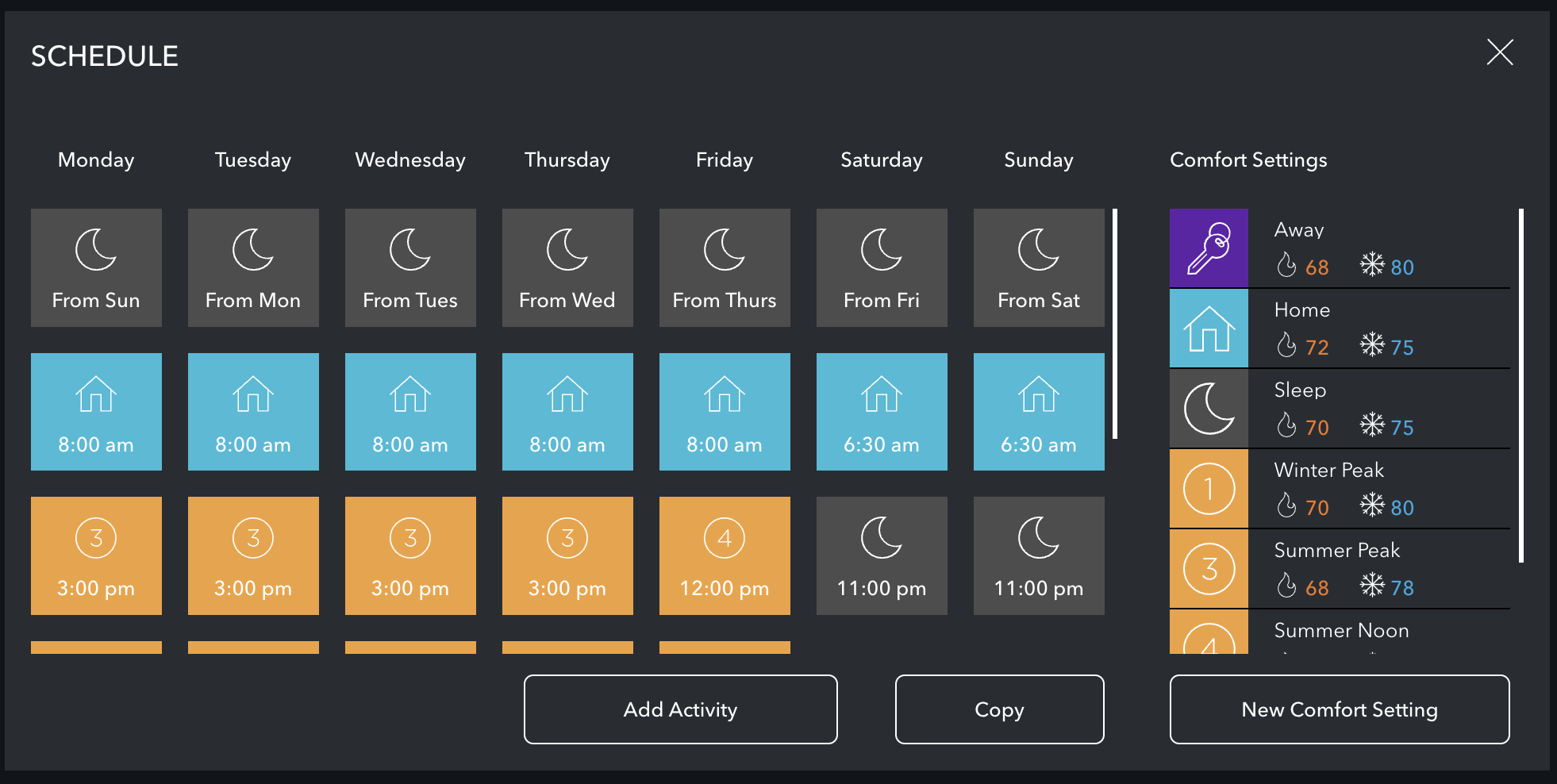
For heating I have
- Winter base rate
- Winter peak rate
- Winter before peak
- Winter after peak
Similarly, for cooling I have
- Summer base rate
- Summer peak rate
- Summer before peak
- Summer after peak
These are mirrors of each other. Summer base rate has a high setting. Winter base rate has a low setting. The schedule consists of a list of start times and the comfort setting to use commencing at that time. Very simple to understand and configure. And immune to accidental adjustments.
Heating peak rate and cooling peak rate provide nominal values to coach the Eco+ algorithm. Eco+ will choose the pre-conditioning value and the period value. The pre-conditioning period is short and designed to adjust air temperature.
The before peak values are picked to cool or heat the rest of the stuff in the building interior and the inner wall surfaces.
The after peak temperatures are between the peak temperatures and base temperature. It is likely 3 values are sufficient.
What a Day Looks Like
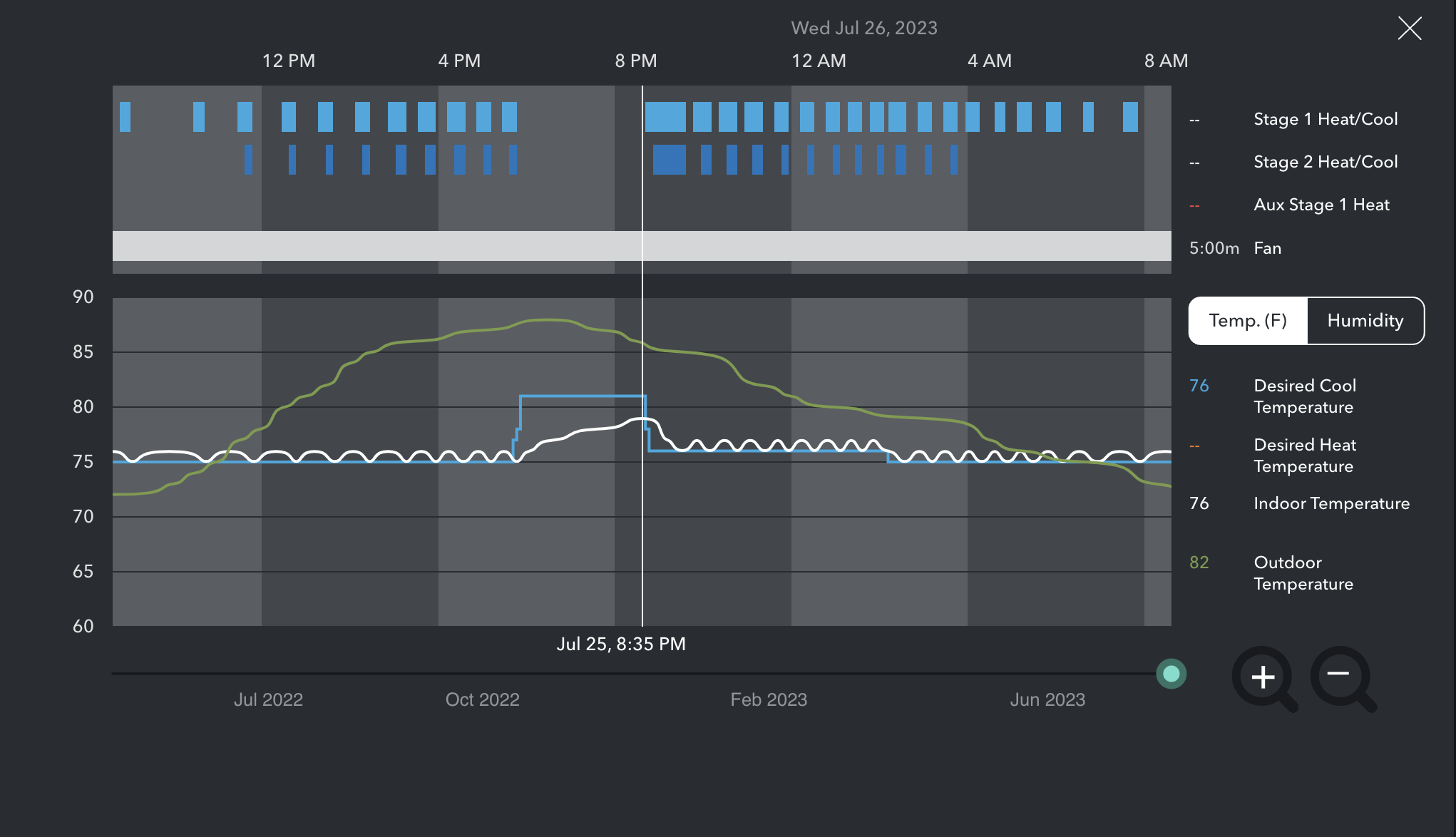
Over night pre-cooling is not interesting. Basically, the air con maintains 75F cycling as needed at a somewhat lower rate than shown below. Keep in mind that the afternoon set point mesa is from 3 PM to 6PM and the time scales are wrong. The green curve is the air temperature from ORF Airport next door.
At 3 PM, Dominion’s demand management system raises the cooling set point by 5F degrees. During rush hour, the building warms by about 3 to 4 degrees. Coming out of rush hour, the thermostat resumes the program and the building quickly cools (about an hour) to the evening set point.
As you can see, the afternoon set back catches the afternoon peak temperature (green) pretty well. The electric usage peak happens because workers are returning home, setting cooling on or cooler, and beginning supper preparation. By 6PM, the sun is low enough that solar gain is dropping and solar generation is asleep for the evening.
There are two sides to the coin. What is humidity (and latent heat) doing during rush hour? There’s a fair bit going on here. First, the time notation is off (there’s a bug). Second, cooling stopped at 3 PM and resumed at 6 PM. Humidity went up a little bit but was flat for most of the rush hour. When cooling resumed, the excess moisture was removed. The humidity was never high enough for the building to feel sticky.
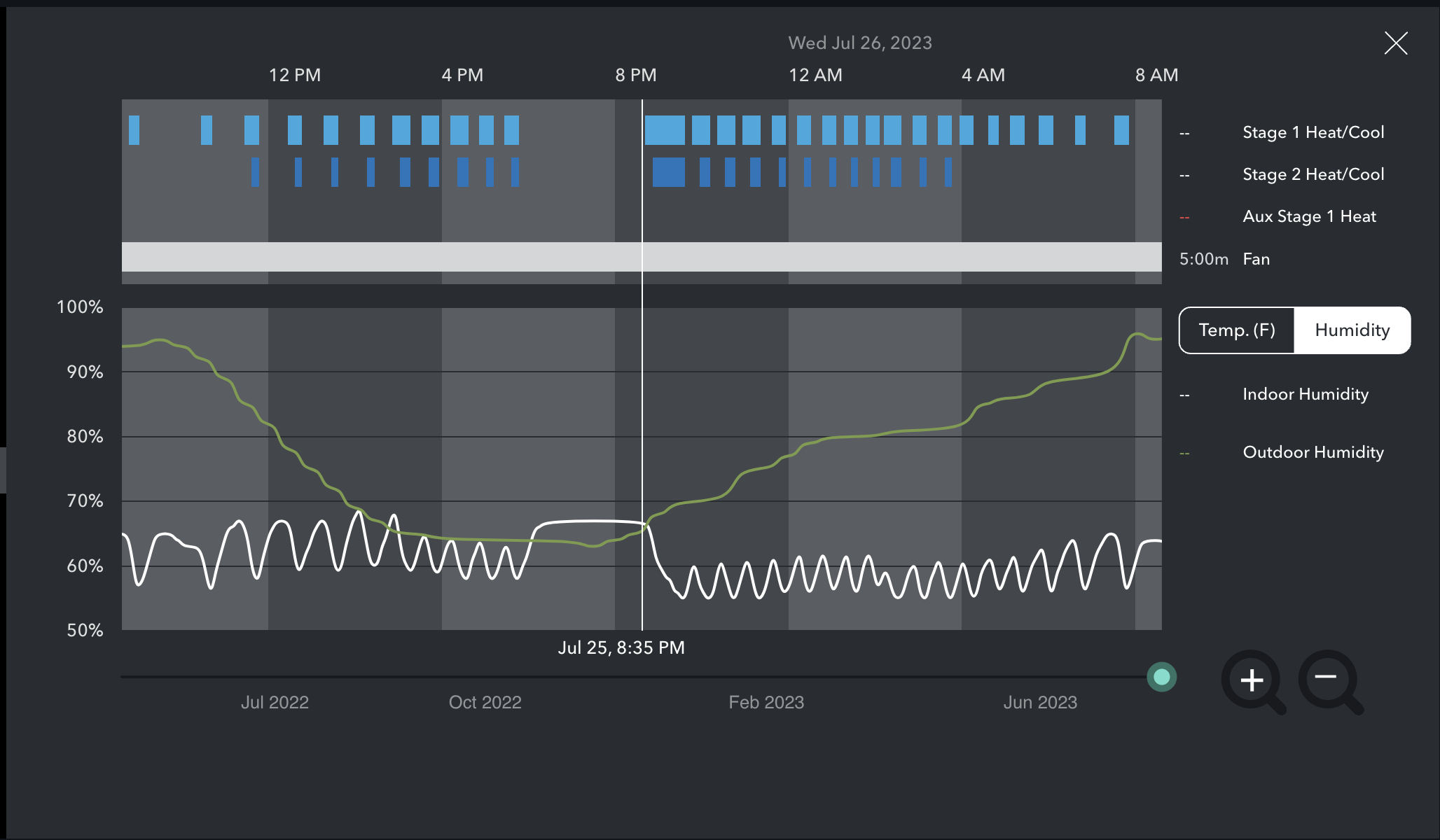
Notice that the green outdoor temperature and relative humidity curves are mirror images. That suggests that air moisture is relatively constant but RH is responding to the temperature change of the air.
The sawtooth results from the machine cycling on and off during the cooling period. Our Lenox Elite 16 is a 2 stage 16 SEER cooler. Although 17 years old, it meets current DOE minimum performance standards.
The green line represents the outside relative humidity. It is a minimum in the late afternoon, a good time to do yard chores in the shade. Over night, as the air cools, relative humidity rises until the air temperature and dew point temperature are the same. Then latent heat from the moisture holds temperature up as water vapor changes to dew.
Shoulder Seasons are Different
Spring (May and June) and Fall (September and October) are different. First, there is morning rush hour from 0500 to 0800. The milder day time temperatures allow over night pre-heating or pre-cooling to be effective. Rush hour happens. The machine stops. Rush hour ends. The building is still in limits so no run-time happens until late afternoon

 Dismal Manor Dispatches
You must be logged in to post a comment.